
Polaroid Polymorph
By A&U | April 21st, 2011 | Category: Features | Comments OffA New Exhibit of the Work of Mark Morrisroe Shows How the Artist Pushed the Boundaries of Photography & Identity
by Angela Leroux-Lindsey
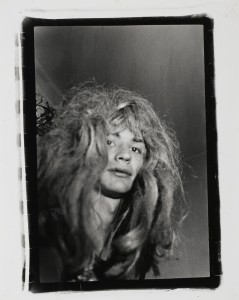
Untitled [Self-Portrait, 1986, silver gelatin print © The Estate of Mark Morrisroe (Ringier Collection) at Fotomuseum Winterthur
haunted, but not self-conscious; swathed in a halo of blond wig and wearing a hint of a smirk, it’s almost as if he’s challenging the viewer: Subjectify me, I dare you.
But that’s not the point; it’s the shifting conceptualization of the subject that Morrisroe’s body of work announces. Consisting of over 2,000 photographs, prints, and films, his oeuvre spans a period of just ten years, and the deeply personal nature of Morrisroe’s work is enhanced by its bold creativity and technical innovation.
He often used a photograph as a canvas, drawing and writing around the image, troubling cultural norms, alluding to instant gratification, transparency, accessibility. This doubled approach, in turn, provokes a layered interpretation of the social constructs he captured in Boston in the late 1970s and then New York in the eighties.
This month, the Artists Space gallery in New York will host the first comprehensive exhibit of Morrisroe’s work in the United States, titled “Mark Morrisroe:

Ramsey, Lake Oswego, 1988, C-print, negative sandwich © The Estate of Mark Morrisroe (Ringier Collection) at Fotomuseum Winterthur
From This Moment On.” It’s a homecoming of sorts for his work, which was exhibited as part of group shows at Artists Space in 1985 and 1989, and the first since Morrisroe’s estate has been housed at Fotomuseum Winterthur in Switzerland, where his work has been carefully sorted and archived. Richard Birkett, curator of Artists Space, chatted with me via e-mail and says that “[t]he exhibition is really the accumulation of several individuals’ ongoing commitment to Morrisroe’s work, to the importance of his practice as an image-maker. It focuses on an incredible body of work that is at risk of being marginalized within a broader art discourse due to the artist’s death at an early age.”
Born in Boston, Morrisroe had a tough childhood, and by fifteen was hustling to earn money. At seventeen he was shot by a client, an event he would later draw from in his art, and a year later he enrolled at the School of the Museum of Fine Arts. There, he befriended other emerging artists like Nan Goldin, Stephen Tashjian (also known as Tabboo!), and Jack Pierson, whom Morrisroe dated, and found the instrument with which he would start a career: the Polaroid camera.
The Polaroid company—no doubt intrigued by the relentless energy and ambition the young photographer exuded—supported Morrisroe during these early years, providing him with a Model 195 Land camera, which allowed for negatives to be produced, an integral part of Morrisroe’s experimental development process. Birkett says, “This exemplifies the dual nature of Morrisroe’s work—from the small Polaroids that have an instant, diaristic quality, to enlarged prints where imperfections on the surface of the image become emphasized and played upon, the negative acting as a site for almost painterly experimentation.”
Morrisroe and his peers pioneered the “sandwich print,” a sort of doubling over of negatives that produces a more abstract image, which Morrisroe often augmented with inscriptions or drawings in ink or marker.

Untitled, 1988, colorized gelatin silver print, photogram of X-ray © The Estate of Mark Morrisroe (Ringier Collection) at Fotomuseum Winterthur
During his time at the MFA School, he displayed an unrelenting creative drive and produced hundreds of photos, often featuring his friends in varying poses, guises, states of undress; sometimes his subjects address the camera, posing, and others appear to be captured in a candid moment. Taken together, the collection is a compelling subversion of the real/surreal dichotomy, and his handwritten additions embed a cultural historicity. “It seems to me that he moved beyond questions of photogenic ‘truth’ or ‘falsehood,’ by honing in on the surface of the image, its augmentation and reconstruction. He built on notions of projected selfhood that were prevalent in post-punk and camp performance, and were again about surface characteristics—drag, body painting, masquerade.
Sexuality is portrayed in a similar way, conveying a sense of mutable physicality and emotion. Mark seemed to revel in the abstract notion of degradation as a site of glamour and performance…he was interested in the theatricalization of his social context—he takes a step back from the things around him and sees them as signs to be played with. In many ways this relates to a contemporary experience of images, that in their proliferation through digital media become dislocated, open to manipulation.”
Morrisroe was diagnosed with HIV just a year after he arrived in New York, and died three years later, at age thirty. He continued to create during this time, and began to experiment with found materials and collages, sometimes using pages from magazines, moving away from images of other people. As he grew more ill, he set up ad hoc darkrooms in hospitals, continuing to layer negatives and push the boundaries of his medium. Birkett says of Morrisroe’s later work, “The still lifes and sparser images of objects and animals have a melancholic character that is incredibly emotive. They reference classical notions of memento mori, and in this respect suggest an inward turn.”
In 1988 Morrisroe created a triptych of gelatin silver prints made from X-rays of his chest, each painted a different bright color; the following year he created black-and-white prints, again of chest X-rays, this time revealing the bullet that had been lodged next to his spine since 1976. He also took black-and-white Polaroid self-portraits, his thin frame a startling revelation of the extent of his illness.
Morrisroe’s tragic early death tempts us to wonder how his talent would have matured, or if his fame would have affected the then still-inchoate discourse
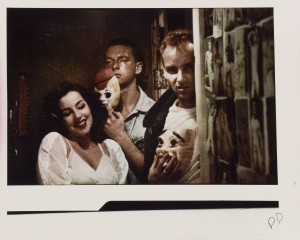
‘Nymph-O-Maniac’ Promo Still Spectacular Studios [Pia, Richard, Nathan, 1984, C-print, negative sandwich © The Estate of Mark Morrisroe (Ringier Collection) at Fotomuseum Winterthur
“Mark Morrisroe: From This Moment On” will be at Artists Space through May 1, 2011. Artists Space is located at 38 Greene Street, 3rd Floor, New York, New York 10013.
Angela Leroux-Lindsey interviewed Jack Mackenroth for the November 2010 cover story.
April 2011
