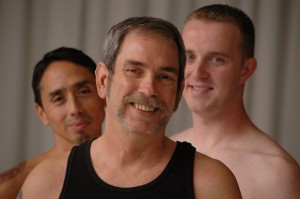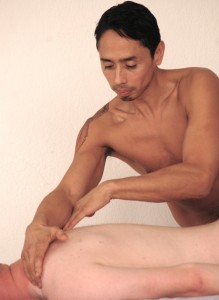
Tim Courtney
Ruby’s Rap by Ruby Comer
“Ruby, do you want to play doctor? This time let me be the doctor, okay?”
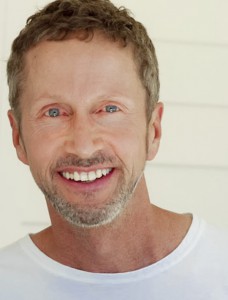
This childhood memory flashes through my noggin’ when I see an old chum, Tim Courtney, at an AIDS fundraiser in San Diego.
Tim and I used to be neighbors and one time during middle school, he accompanied me to the Sadie Hawkins dance. But before high school, he and his family moved away and I lost track of him. We hooked up again in Los Angeles in the nineties when an old boyfriend of mine, Greg, started dating him. Yes, I drove Greg gay! I learned then that Tim was a photographer so I connected him with A&U magazine, where he shot many covers. For nearly fifteen years we haven’t been in contact.
After the event, Tim invites me to his charming Hillcrest apartment and we catch up.
He has been HIV-positive since 1990 and, fortunately, has had no AIDS-related illnesses. Over the years he’s been an active volunteer, dedicating many hours to Los Angeles’ Project Angel Food (“I enjoyed working there and still use a recipe of theirs, pineapple sour cream pie!”). Several years ago he established his own nonprofit organization, Picture Me Happy, helping children who are afflicted with terminal illnesses.
Tim has been to hell and back with addiction; however, he’s been sober for nearly ten years. He offers to share his story since he feels it might help others, so straight away I pull out my trusty digital recorder from my cherry Fossil handbag. We huddle together on his balcony that overlooks a low-lit urban street and we bask in the bright glow of the dazzling la luna above.
Ruby Comer: Tim, do you remember when you first heard about the epidemic?
Tim Courtney: It was probably in 1983 when I was in college. I really wasn’t educated about it, other than it was something to do with sex, and that men were dying from it. I remember the first man I allowed to penetrate me—without a condom. I later found out that he had a wife. In all honesty, I didn’t know that a guy could put his penis into my anus until this man did and I had no idea what a condom was used for.
A year later I was informed that he had AIDS, was in the hospital and dying. I well remember my mind going beyond the fear and straight to feeling numb and disconnected with everything in life. To give you an idea of how it affected me, I had received this information early on a Sunday evening. I went to sleep that Sunday night and arose from bed to go to class the next morning, only to find out when I arrived at class it was Tuesday morning. I had slept from Sunday night to Tuesday morning.
Wow, that knocked you for a loop, boy! Of course….
I’ve lost many friends to this epidemic and did help take care of a few, especially my former partner’s good friend, Danny. Memories come up of things I did to help him achieve his last dream before passing: to maintain some dignity and still feel like he was an attractive man. [Tim becomes very quiet, reflecting.] I can think of so many who passed too soon before the cocktail medications came out. They were so young; many were in their early thirties. As you know Ruby, my first partner Greg, who had once been your boyfriend, passed away in the early 2000’s from AIDS.
I heard about Greg. What a fun time the four of us (my fiancé Rudy) had that one New Year’s Eve in Palm Springs, huh?! After your diagnosis how did it affect you?
The first year was horrible, everyone was dying, and my spirit was dying on the inside. About a year after my diagnosis, while I was songwriting and in a severe drama of imminent self-pity, it occurred to me that I was still alive. I took back my life that day realizing I might be alive even another year. Did I want to spend it the way I had just spent the last year?
How did you discover you were positive?
About two months prior to my next HIV testing, I contracted a severe flu. People used to ask, “Who do you think gave it to you?” My response is still the same, “What does it matter? What does it have to do with who it was? I was the one who was there, with my low-self esteem and compulsive decision for bare sex.
Indeed. What medical treatment did you seek?
I have to tell you, Ruby, my very first doctor gave me the best advice ever. He said, “Do what you believe is right for you.” I waited till the first cocktail drugs came out before taking anything. My belief was and still is today, quality of life versus severe side effects and longevity of life. I quickly learned that my little body could not handle the regular dosages, so I made an adjustment. I take only about a third to a half of what is prescribed. Through the years I have also taken five or six-month breaks from medications in order to clean out my system. I don’t recommend it to others, but this has been my experience.
I’ve always believed that everyone needs to do what is best for them, not just what a professional advises. It’s so easy to sit back, be told what to do, and not take any responsibility. So easy….
I think it works well if you believe it does. [I nod.] And the monitoring test can be good proof to back it up. I’m currently on a one-pill regimen of Stribild. I take half every night before bedtime, along with 1,000 mg of Vitamin C. I also take 1,000 mg of Vitamin C twice a day, and always one along with my HIV meds. Fortunately, I continue to have excellent numbers.
YEAH! [We hug.] Do you do anything else alternative?
I am a big fan of Zyflamend, a 100-percent pure fish oil pill, and Holy Basil, all made by the company New Chapter. When needed, I take liquid silver, a natural antibiotic. I find it helps with sinus infections and allergies. I work out to keep the body active and lively. I’ve been working out in the gym with both weights and cardio since I was nineteen years-old. Exercising has absolutely made a positive difference in many areas of my life, and continues to do so. I also eat very healthy, most of the time, though as you know Ruby, I love my sweets!
Join the club, Tim! What inspired you to found your organization Picture Me Happy?
I wanted greater fulfillment in life. I began volunteering my photography services at Los Angeles Children’s Hospital. I saw a real need for the creative project I was offering to the children. They were engaged with the creative process and it got them into the playrooms. It also worked well for those who were at bedside.
What year was it established and tell me what it does exactly.
It was created in 2007. Picture Me Happy inspires the healing process through creative arts for hospitalized children with serious medical conditions, such as cancer, leukemia, AIDS, sickle cell, pulmonary disease, and other chronic and terminal illnesses. We currently serve children’s hospitals in Long Beach and San Diego. And we’ll soon be expanding a number of programs, adding more variety and activities for children and teens.
What motivates you to continually offer yourself to others? Oops, maybe I should ask that in another way. [We both cackle hysterically.] 
I have learned that I have a choice to work on the solution or to be a part of the problem. I used to cry watching commercials showing children and adults going through horrible life circumstances. I cried and whined, but I didn’t bother to be active. [He declares in an assertive voice:] Get into the solution and help better the situation! I realized my crying and sadness had a lot to do with me, not them. I can’t help everyone, but when I choose one [an organization], I’m working alongside millions of other caring people who are helping to create a better world together.
Ya know, my friend, I want to know more about your addiction.
Oh my…First of all, this isn’t me being very anonymous [according to AA rules one needs to remain nameless], but I hope this will be of benefit to someone.
I spent eight years of my life committed to meth, and lots of alcohol before that. I say committed, because it got to a point where I couldn’t not do it. As those using years passed, I was dying more and more on the inside and looking like death on the outside. The bottom for me was a Thanksgiving evening when I didn’t show up at a friend’s big dinner. I was in my apartment on my bed, convulsing, while a friend was on-line looking for his next trick. Ignoring my flipping around all over my bed, he left me, but with a big bag of drugs to help. I knew I needed to get to a hospital; I was going to die. It seems I was about to get what I wanted…the final escape. Here I was finally going to get out of this life that was too hard and painful for me to live in. But…I really didn’t want to die. [As an afterthought, Tim laments with a chuckle:] My goals and dreams had never included, “I want to be an alcoholic or an addict!”
So what happened next?
I woke the next morning and admitted to myself, “I…need…help.” Very weak and degraded, I got myself dressed and drove to a noon NA [Narcotics Anonymous] meeting in West Hollywood. With gratitude, Ruby, I persevere in my recovery to this day. I discovered a life worth living.
◊
For more information, visit TimCourtneyphotography.com and PictureMeHappy.org.
◊
Ruby Comer is an independent journalist from
the Midwest who is happy to call Hollywood her home away from home. Reach her by e-mail at MsRubyComer@aol.com.