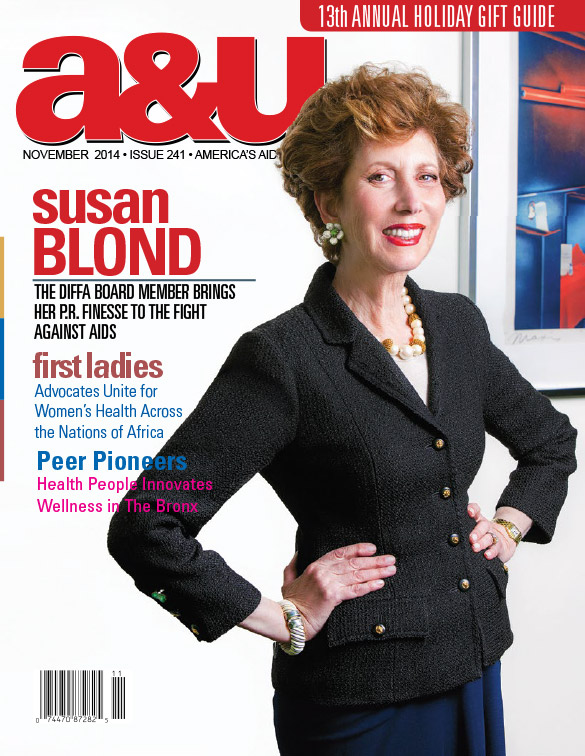
Blond Ambitions
Susan Blond strives to better the lives of individuals living with HIV/AIDS through her work with DIFFA
by Lester Strong
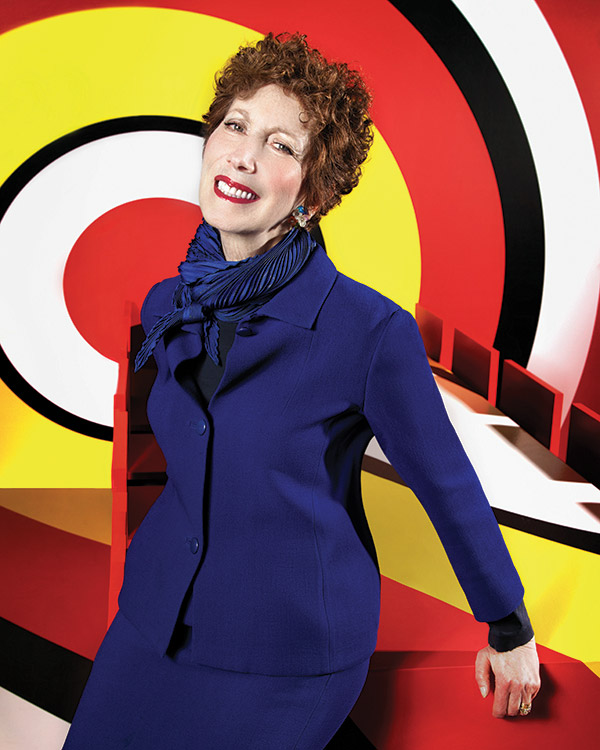
Photographed Exclusively for A&U by Sean Black
Susan Blond: You may not recognize the name. But you’ll certainly recognize the roster of celebrities and organizations she’s represented over the years as press representative first at United Artists, then at Epic Records, and finally as head of her own public relations firm Susan Blond, Inc.: Michael Jackson, Shirley Bassey, Cyndi Lauper, Sade, Ozzy Osbourne, Meat Loaf, Tina Turner, Julio Iglesias, Morrissey, Culture Club and Boy George, Target, Steve Madden, Armani Exchange, Skechers….
The list could go on and on. But let’s add one more: DIFFA, or the Design Industries Foundation Fighting AIDS. Not only has she worked with it professionally, but for some years now she has served as Secretary on its Board of Trustees.
Clearly this is a woman deeply rooted in the entertainment industry. Interviewed recently about both her professional life and DIFFA, it is equally clear she is someone who knows how to use her talents to promote a good cause.
The path to public relations, let alone to DIFFA, was not direct. A native New Yorker, her first love was visual art. “My father did caricatures at the 1939 World’s Fair, and my mom went to art school,” she explained. “They brought me to every museum show. My best friend Jeffrey, whom I grew up with in Queens, and I would take a bus and five subways every school day to New York’s High School of Music and Art in Harlem” [since then merged with the High School of Performing Arts to form the Fiorello H. LaGuardia High School of Music & Art and Performing Arts, located near Lincoln Center on Manhattan’s Upper West Side].
From high school, Blond went on to study art at Harvard, where she was given a one-woman show, and William Randolph Hearst III was the first person to start collecting her work. Once out of college and back in New York, she was accepted into the Whitney Museum Independent Study Program, during the same year in which Julian Schnabel was a participant.
Then Andy Warhol entered her life. This was in the early 1970s, a few years after Warhol had been shot and nearly killed by Valerie Solanas in 1968, and things were much quieter around his studio than they had been before that incident. Nevertheless, the studio, known as The Factory, was still an exciting place to be, the hangout of people like artist David Hockney, actor Jack Nicholson, and other celebrities or soon-to-be celebrities. It was Paul Morrissey, director of many Warhol films, who introduced her to Warhol, and Warhol took an instant liking to her. “I like your name. I like your voice. You’ll be in all our movies,” she reports him as saying. And, indeed, she did appear in several Warhol movies, including Bad (1977) and Madame Wang’s (1981).
She and Warhol became good friends. “He would always take my calls. Always. I still can’t believe it,” she said of this world-famous artist, who until his death in 1987 following gall bladder surgery faced enormous demands each day on his time and energy.
Asked her assessment of his art, she said, “He was the best in the world, and always will be. I can say that only about one other person I worked with: Michael Jackson.”
Asked if Warhol influenced her art, she replied: “No. Life around him was so exciting I stopped painting.” Instead he hired her to work on his magazine Interview. “My art became interviews I did for the magazine, underground TV series and shows I was in, Warhol movies I was in,” she explained.
Asked how he influenced her as a person, Blond answered: “He was the ultimate publicist.” By which she meant that Warhol introduced her to a new career.
At Interview her main focus was advertising. “After a year or two at the magazine, Marv Greifinger at United Artists Records thought I’d be perfect for a publicity job there. I loved music and admired the writers and wild personalities at the company, so I moved on. Two years later I went to Epic Records, and had a ball there.” She also became the first female vice president of Epic Records, something of a feat in the early 1970s to mid-1980s when the glass ceiling was much more confining for women in corporate life than it is today.
In 1986, she founded her own public relations company, Susan Blond, Inc. As noted at the start of this article, she has represented many big-name celebrities and big-brand corporations over the years. Asked if handling such a diversity of clients requires different skills and approaches, she said, “It sure does. But that’s what keeps it exciting. You have to find out what the story is, and then who in the media can tell it best.”
Although still enthusiastic about public relations work, Blond has recently decided to close shop on Susan Blond, Inc., as it has been structured till now. “I will always be working on a few projects I really love, but not with the huge offices and staff I once had. It’s an exciting time. One of my favorite clients, Scott Mirkin of ESM Productions, is producing an event with the Dalai Lama in Birmingham, Alabama, in a few weeks.”
Another organization she will be continuing to work with is DIFFA—which returns us to the subject of AIDS.
According to Blond, back in the early 1980s she like most people in New York had a rude awakening to the reality of the disease. She explained: “All of a sudden you would see someone you knew on the street and you could barely recognize them. Their cheekbones were there, but that’s all. It seemed like everyone was getting sick. Many were dying.”
Among those who were sick was her best friend from childhood, Jeffrey. “I was hands-on in my care of Jeffrey,” she said. “He died such an awful death from AIDS. My first two boyfriends in high school died young. Then it seemed like everyone who was fabulous in my personal and professional life was dying: writers and editors like Robert Hayes, Henry Post, and Peter Lester; photographers Bill King and Peter Hujar; makeup artist Way Bandy; musicians John Outlaw and Dan Hartman; Studio 54 owner Steve Rubell. In those days we all had Rolodexes. When someone died I couldn’t bear to take their cards out, so I wrote “DEAD” across them. It seemed like all my pals were going. There’s a certain void in my life with those important deaths. I can’t ever replace them. The world lost so many talented people.”
She continued: “I’m a cancer survivor, and I think that has helped me be more empathetic with others living with disease, whether the disease is in check or not.”
Over the years, Blond has worked with a number of AIDS organizations, including Lifebeat, the music business AIDS fundraising group; T. J. Martell, which concentrates on leukemia, cancer, and AIDS research; and the Correctional Association of New York, which advocates statewide to improve the conditions of prisoners with AIDS. But DIFFA has been her main focus.
Asked how she joined DIFFA, she answered, “Around twenty years ago, Dan Baldinger [1933–2007] of Baldinger Architectural Lighting, and at the time National Chairman of DIFFA, asked me. He had made DIFFA into an organization that raised significant amounts of money each year in order to support AIDS groups around the country. I wanted to see what I could do to help. I hoped my expertise in publicity and my connections in the entertainment and design communities could make a difference, and saw my efforts as a way to commemorate my friends who had died of the disease and help ensure their deaths would mean something. Also, I’ve always liked a good party, and DIFFA holds the most exciting events each year, especially its Dining by Design.”
Dining by Design has been called DIFFA’s signature event, and it is certainly one of its largest fundraisers. Bringing together internationally celebrated individuals and groups from all design fields, as well as local talent, at different venues across the country to create unique, intriguing, three-dimensional dining environments, it offers those who attend not just spectacular surroundings in which to dine on sumptuous meals, but the chance to meet the designers who created the environments and to participate in a silent auction whose proceeds are also channeled to AIDS organizations around the country. This year’s Dining by Design New York [A&U, May 2014], held March 20 through 24 on the city’s Hudson River Pier 94 in conjunction with Architectural Digest’s Home Design Show, alone raised over $700,000.
Other DIFFA fundraising initiatives include Picnic by Design, Trick or Treat for DIFFA, Shop for a Cause, Specify with Care®, and Design in Kind.
In its literature, DIFFA describes itself as “one of the country’s largest supporters of direct care for people living with HIV/AIDS and preventive education for those at risk. Merging care and commerce, supporters of DIFFA come from all fields of fine design and the visual arts, including: architecture, fashion design, interior design, photography and consumer product design.” It also states that it has granted funds to public policy initiatives which add resources to private-sector efforts.
Since DIFFA’s start in 1984, it has distributed over $40 million to AIDS organizations around the country. Grantees have included Gay Men’s Health Crisis, Alpha Workshops, the International AIDS Conference, East Texas Cares, Resource Center Dallas, University of Southern California/Positive Health Program, Calvary Outreach Services, Kansas City Free Health Clinic, AIDS Legal Council of Chicago, Asian Human Services, The Catholic Charities, Heartland Human Care Services, Inc., Test Positive Awareness Network, and Vida/SIDA, among many, many others. It was an early supporter of a number of trailblazers whose work led to the creation of such organizations as the AIDS Medical Foundation (the predecessor of today’s amfAR), San Francisco’s Open Hand, and New York’s God’s Love We Deliver and Bailey House; it also financially supported a meeting of the National Urban League that gave birth to the Black Leadership Commission on AIDS [A&U, March 2001].
Over the years, DIFFA has expanded from its original New York City base into a network of chapters and community members in Chicago, Detroit, Kansas City, Dallas, San Francisco, and Seattle. The groups hold their own events, and host national tours of Dining by Design outside of New York. On DIFFA’s Board of Trustees, aside from Susan Blond, sit such design and architecture luminaries as Cindy Allen, Editor-in-Chief of Interior Design magazine; David Rockwell, founder and head of the architecture and design firm Rockwell Group; Marc Blackwell, head of the design firm Marc Blackwell New York; Kelly Wearstler, head of Kelly Wearstler Design; and Alfredo Paredes, Executive Vice President and Chief Retail Creative Officer of Ralph Lauren; also on the board is Whoopi Goldberg [A&U, June 2000], the actress.
In regard to being on DIFFA’s Board of Trustees, Blond commented: “I’m one of the few women in business I know of who didn’t start as a secretary. So it’s funny that as Secretary of DIFFA, I finally became one. I’m very honored to be on such a prestigious board.”
Talking about her life these days, Blond commented: “Art still makes me happy. I know that sounds funny, because I’ve worked with musicians for the last forty years. But the other day I went to the Museum of Modern Art to see the Matisse cut-outs show on view there into February 2015, and next week I’ll go to the Metropolitan Museum of Art to see Leonard Lauder’s cubism exhibit, also running into next February.”
Commenting on her friendships with Andy Warhol and Michael Jackson, Blond added: “Wasn’t I a lucky girl?”
But this is also a woman who recognizes that not all people are as lucky as she, and her perspective on AIDS is long term. “This disease is not going away,” she said. “It’s hitting Hispanics and African Americans the hardest now, especially the women. I feel we must keep our efforts going because with all the medicines available these days people forget how large a problem it still is, and that even though many people are living longer now with AIDS, it’s not an entirely comfortable life. We must continue raising funds that are needed to make things better for everyone suffering from the disease.”
Susan Blond is indeed a lucky person, but a lucky person with a heart. The world—and especially the AIDS world—is lucky to have her as part of it.
◊
For more on the Design Industries Foundation Fighting AIDS, its grants, and its activities, go to its Web site: www.diffa.org.
◊
Hair by Colin Lively: www.ColinLively.nyc; Makeup by Sarah Bandy; Post-production by Eve Harlowe: www.EveHarlowe.com.
◊
Lester Strong is Special Projects Editor of A&U. He interviewed Martin Duberman for the March cover story.