Tags Posts tagged with "Jonathan D. Katz"

Jonathan D. Katz

0 557
Thomas Haukaas, born San Juan, Puerto Rico, 1950, Tribal Affiliation: Sicangu Lakota, More Time Expected, 2002, handmade ink and pencil on antique ledger paper, 16 1/2 by 27 1/2 inches. Tacoma Art Museum, Gift of Greg Kucera and Larry Yocom in honor of Rock Hushka, 2008.

Taboo Art
Art AIDS America touches the art world’s third rail
by Larry Buhl

Tino Rodriguez, born Ciudad Obregón, Sonora, Mexico, 1965, Eternal Lovers, 2010, oil on wood, 18 by 24 inches. Private collection

The curators of Art AIDS America, which opened with a sneak preview in West Hollywood in June, say the show is about what the gatekeepers of the art world still consider the disease as third rail of American art. That is, HIV/AIDS. More specifically, what spooks the top of the art world hierarchy is portraying HIV/AIDS as a disease that’s changed but still here, and has pervaded a wide swath of American culture.

The West Hollywood exhibit, split between the West Hollywood Library and the ONE Gallery, contains about a third of the art included in the full show, which opens October 3 at the Tacoma Art Museum in Washington. The partnership with West Hollywood is significant because that city was founded thirty years ago partly in response to a lack of response to the AIDS crisis by surrounding Los Angeles and L.A. County.

From Tacoma the full exhibit moves to the Zuckerman Museum of Art in Kennesaw, Georgia, in 2016 before closing at the Bronx Museum of the Arts in New York. The dates of the post-Tacoma shows are still tentative.

Some big names are supporting the exhibit, including The Andy Warhol Foundation for the Visual Arts, The Paul G. Allen Family Foundation, Leslie-Lohman Museum of Gay and Lesbian Art, The David Geffen Foundation, and Gilead Sciences, Inc. But it took almost ten years to find money and venues for the exhibit, according to co-curators Jonathan D. Katz and Rock Hushka.

One would assume with their backgrounds—Katz co-curated the exhibition “Hide/Seek: Difference and Desire in American Portraiture” at the National Portrait Gallery, and Hushka reconstituted Hide/Seek at the Tacoma Art Museum where he’s the curator—would make the exhibit an easier sell. Sadly, no.

“Hundreds of museum directors said no, and one came out and said ‘love the idea but AIDS is such a downer,’” says Katz, who is director of the doctoral program in visual culture studies at State University of New York at Buffalo.

Katz adds that the response of the art world—as opposed to the artists—is still that AIDS as a topic was a “literal dead end.”

Hushka agrees. “Many exhibitions have this arc where there is an artist response to a crisis and then a happy ending,” he says.


Kia Labeija, born New York, NY 1990. 24, 2014, Inkjet print, 16 by 24 inches. Courtesy of the artist


“But with HIV/AIDS, there’s no resolution. There’s no happy ending yet. It’s happier now, and that’s part of the complexity of the endeavor. We don’t have hundreds of people dying every week, but another person seroconverts every ten minutes.”

Hushka and Katz say the choice of pieces in Art AIDS America, which spans the earliest days of the crisis to the present, underscores a point that AIDS has been an active and shaping force in American culture, not a tragic tangent. And definitely not over.

Katz has more pointed criticism of the art world gatekeepers who are skittish about what they consider difficult subject matter. “Art museums rely on boards of directors, their wealthiest donors. It’s about keeping a very narrow class, a point one percent happy. Many of them have an investment in keeping a social hierarchy. They are big- and small-c conservative.”

Culture wars and post-modernism
Katz wanted the show to be acknowledgement of the role of AIDS in the development and definition of American art, and how it influenced the work of artists who had no idea that the social and political codes they deploy had roots in AIDS.

“At the moment AIDS presented itself in the early eighties there were two powerful forces arrayed against any art about AIDS. There was an orthodox post-modernism ruling the roost in the eighties, the idea we no longer have authors because meaning is a product of the viewer. Expressiveness was considered old-fashioned and making a statement was a futile gesture, because it will always be subject to the viewers’ understanding.

“The second force was the widespread homophobia and AIDS phobia,” he adds.

Those forces combined to produce a dominant strain in American art today, which Katz says tends to be anti-authorial and unexpressive with its intent camouflaged. And that approach goes beyond so-called “AIDS art.”

Take the 2003 video by Rudy Lemke, called “The Uninvited.” Comprised of hand-made shadow puppets, the narrative is ostensibly about the Vietnam war and regret through the lens of a homeless veteran with AIDS. The viewer is supposed to stand between the projector and the projection on the wall so their shadows mingle with the puppets, in an attempt to refute the “othering” of people with HIV/AIDS, inviting an empathetic relationship with the homeless vet with AIDS by seeing themselves mingled with his shadow.

But you don’t have to see the piece that way, Katz says. “It has a specific AIDS content under the nose of dominant culture. If it was overtly about AIDS it would have had no chance of museum display.”


Thomas Haukaas, born San Juan, Puerto Rico, 1950, Tribal Affiliation: Sicangu Lakota, More Time Expected, 2002, handmade ink and pencil on antique ledger paper, 16 1/2 by 27 1/2 inches. Tacoma Art Museum, Gift of Greg Kucera and Larry Yocom  in honor of Rock Hushka, 2008.
Thomas Haukaas, born San Juan, Puerto Rico, 1950, Tribal Affiliation: Sicangu Lakota, More Time Expected, 2002, handmade ink and pencil on antique ledger paper, 16 1/2 by 27 1/2 inches. Tacoma Art Museum, Gift of Greg Kucera and Larry Yocom in honor of Rock Hushka, 2008.


Undetectable, but pervasive
Hushka says that in many of the words in the exhibit the AIDS narrative is hard to parse, and therefore able to circulate freely amid the dominant art culture.

“We wanted to show the impact of the activist impulse and how it infiltrated the gallery system, the museum system either by camouflage or disguise,” Hushka says. He adds that at the same time, he wanted to find works that showed how people deal with HIV in their art that “permeates every aspect of their thinking,” using art historical methods that are parallel how HIV is suppressed by antiretrovirals, but still active.

“At the moment when the attempt to police AIDS was most pronounced, a number of artists made work that was the functional equivalent of untitled, and then with a narrative title behind it,” Katz says.

There are many such works in Art AIDS America. Like Untitled (Placebo), a 1991 piece by Cuban-born American artist Félix González-Torres, which consists of 1,200 pounds of shiny silver wrapped candies. Why that specific number? Those familiar with HIV/AIDS terms would know that 1,200 is a normal count for CD4 cells.

Fine arts photographer and filmmaker Ann P. Meredith has two photos in Art AIDS America that were originally part of an exhibit “Women with HIV 1987-1997.” She tells A&U that in 1987 the Eye Gallery in San Francisco was starting a photo exhibit on HIV/AIDS in 1987.

“I wanted to cover women with HIV because nobody was doing women then, but nobody I found wanted to have their photos taken. Nobody. They were scared. They were having children taken from them, which was against the law.”

Bill Jacobson, born Norwich, Connecticut, 1955, Interim Portrait #373, 1992, Chromogenic color print, 24 by 20 inches. Courtesy of the artist

With little more than a week until the opening and still no subjects to photograph, Meredith was going to put up empty frames with statistics. Then she got lucky. While driving from San Francisco to New York she stopped to visit family in Louisiana and saw a billboard saying that AIDS was God’s wrath against homosexuality. Fortunately, she had her camera equipment handy.

“There is still a fear of telling the truth in the art world. And a feeling of, if they don’t see it [HIV/AIDS] they don’t have to think about it.”

Joey Terrill, a thirty-five-year asymptomatic survivor of HIV, tells A&U that his art is personal. The painting he shares in the exhibit is a garish still life that puts HIV onto a dinner table, with oversized blue pills with the GILEAD name next to a Hershey’s bar and Heinz ketchup. There is also a Mexican blanket to underscore Terrell’s Chicano heritage.

“I began my still life series because of my ambivalence about the new AIDS cocktail when it came out. The implication was that HIV drugs are products, like coke, and American consumer goods.”

Katz suggests that an in-your-face show about HIV/AIDS—the kind of work that most people think of as “AIDS art,” agitprop—might have been an easier sell. “AIDS Agitprop is safe and circumscribed today,” because it’s historical, over, and locked in a time capsule. That’s the opposite of the real-life experience of the disease today, thirty-four years into the crisis, and far from the complexity and nuance that the curators sought in Art AIDS America.


For more information visit Tacoma Art Museum and ONE Archives.


Larry Buhl wrote about PrEP education in the July issue.
0 55

[BOOKS]

Hide/Seek: Difference and Desire in American Portraiture
by Jonathan D. Katz and David C. Ward
Smithsonian Books

“Hide/Seek: Difference and Desire in American Portraiture,” which was co-curated by Jonathan D. Katz and David C. Ward at the National Portrait Gallery in Washington, D.C., was the first major museum exhibition in the U.S. to focus on sexual difference in portraiture. In breaking such ground, the Gallery incurred a bit of controversy, which resulted in the pulling of a video by artist David Wojnarowicz that combined Christian and homoerotic images to critique ideas about AIDS and victimhood.

In his introduction to the handsome volume that documents the exhibit, Katz describes the history of AIDS censorship in American art, which found its bellwether in North Carolina Senator Jesse Helms, who “repeatedly and aggressively sought to pair homosexuality with AIDS in the context of artistic representation.” Most famously, Helms’s 1988 amendment to a huge AIDS research bill barred the Centers for Disease Control from allocating any of its funding for AIDS education/prevention materials or otherwise “encourag[ing] or condon[ing] homosexual activities or the intravenous use of illegal drugs.”

The bill thus outlawed risk reduction to the two groups most affected by HIV while also conflating AIDS, homosexuality, and drug use in the American consciousness; that this amendment passed by a walloping 94-2 says much about the public’s willingness at that time to quarantine these groups, whether literally or figuratively, as the unseeable “other.”

Ironically, several of the artists Helms most sought to censor, including Mapplethorpe and Wojnarowicz, achieved higher visibility as a result of these witch-hunts—Mapplethorpe particularly is now regarded as one of the most important photographers of the 20th century. In his 1988 Self-Portrait, taken the year before he succumbed to AIDS, the artist winkingly poses as Death; the entire photo is cloaked in black, save for Mapplethorpe’s gaunt face staring somberly at the viewer/critic, and his right hand, which grips a skull-topped cane/scepter.

Because the stunning work in Hide/Seek is reproduced chronologically from the nineteenth century to the present, it becomes apparent that following the 1969 Stonewall Riots and the emergence of a politically empowered LGBT population, images of gay people became less coded and more exuberant almost overnight, no longer relegated to the margins of the canvas.

This exuberance and sexual explicitness reached its zenith in the mid-eighties, by which time artists like Mapplethorpe and Keith Haring were finding mainstream success. Sadly, the first wave of AIDS not only brought the literal death of these and countless other artists, it also killed the public’s willingness to see unabashedly joyful and erotic images of gay people.

Whereas this could have meant an unhappy ending to LGBT art (and to this book), it only meant that artists had to be more clever and symbolic in their depictions of the disease, much in the way they had in previous decades been forced to use code in order to depict homosexuality at all.

One of the most ingenious responses to the public’s unwillingness to look squarely at AIDS came from Felix Gonzalez-Torres’ 1991 installation piece, Untitled (Portrait of Ross in L.A.), created from a piñata-like spill of colorful, individually wrapped candies weighing 175 pounds—precisely the weight of Gonzalez-Torres’ deceased partner, Ross Laycock, before his body was ravaged by illness.

As Ward observes of Gonzalez-Torres’ installation, “[t]he viewer is invited to take away a candy until gradually the spill diminishes and disappears; it is then replenished, and the cycle of life, death and rebirth continues.” By literally partaking of the work’s brilliant mix of camp, culture, kitsch, and Catholic communion, exhibit audiences, and readers of Hide/Seek, are confronted with complex notions about AIDS, and about life—that it is at once tangible and ephemeral, sweet and sour.
—Brent Calderwood

Brent Calderwood is a San Francisco-based journalist and poet. Log on to his Web site at www.brentcalderwood.com.

August 2011

0 236

Tacoma-Based Artist and Curator Rock Hushka Helps Create a Different Frame for Understanding the Pandemic
by Karen Fleur Tofti-Tufarelli

Rock Hushka. Photo Courtesy Tacoma Art Museum
When Rock Hushka—co-curator of the art exhibit “Art, AIDS, America” slated to open in 2012 or 2013—was browsing through a renowned New York City independent bookstore around 2006, he looked for new information about HIV/AIDS. “I thought it would be easy,” Hushka says, “but the section was in the basement, on the bottom shelf; under a table; in the back corner….” He realized, then, he says, that, with regard to HIV/AIDS—even in New York—“that there was some kind of acceptable stasis in our culture.”

“One of the reasons for the [exhibit] title ‘Art, AIDS, America,’” Hushka explains, “is that in the nineties it became important for people to understand how AIDS was ravaging Africa, India, Southeast Asia. But…from my perception it sort of tipped to a point—where it was easier to look there than it was to look at ourselves.”

Hushka, director of curatorial administration and curator of contemporary and Northwest art for the Tacoma Art Museum (TAM), continues: “[W]e haven’t as a culture had a thoughtful way to grieve, to understand the impact of AIDS on American culture, and to come to terms with the fact that there are more than one million Americans who are HIV-positive—but the AIDS crisis
has ‘appeared to disappear.’”

Co-curating the exhibit with Hushka is Dr. Jonathan Katz, director of the Visual Studies Doctoral Program at the University at Buffalo, SUNY, and co-curator of a recent exhibit that did anything but disappear in the national art consciousness. “Hide/Seek: Difference and Desire in American Portraiture,” at the Smithsonian’s National Portrait Gallery was the first gay and lesbian-themed exhibit to show at a major American museum.

A media maelstrom ensued when the Smithsonian removed a video, one of 105 pieces in the exhibit, “perceived by some to be anti-Christian,” according to the Smithsonian’s press release.

Now, Hushka, in addition to co-curating “Art, AIDS, America,” is working to “reconstitute” the “Hide/Seek” exhibit to show at the Brooklyn Museum, then at TAM.

Reconstituting “Hide/Seek” would involve securing 175 works, “or appropriate substitutes” in the case of some of the works, such as fragile watercolors that might be hard to ship.

Hushka emphasized that in the museum world, remaking an exhibition is “somewhat unorthodox” and would only be undertaken by “very ambitious institutions.”

“[W]e’re building a partnership with the Brooklyn Museum to determine the feasibilty of all of this,” Hushka says, taking care to remain elliptical as to other specifics.

A parade of “American Masters” in the “Hide/Seek” exhibit lent it a “Wow!” element.

But, with “Art, AIDS, America,” Hushka emphasizes, “[i]f you only bring well-known iconic blue-chip works you’re going to miss a huge part of the story,” so the exhibit will try to bring in the story of how local and regional artists were empowered “to protect themselves and to articulate their experiences….”

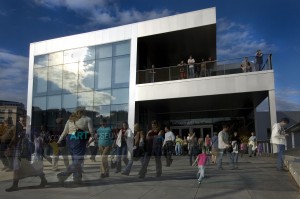
When “Art, AIDS, America” and “Hide/Seek” eventually show at TAM they will be displayed in a modern building of grey concrete and

Tacoma Art Museum. Photo Courtesy TAM
stainless steel that somehow manages to summon forth the Pacific Northwest energy of a seagull in flight, with views of nearby vistas—the neighboring historic districts, waterway, and Mount Rainier.

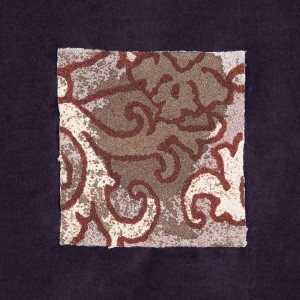
Similarly, Hushka, whose office includes a French press perched casually on a pile of books behind his desk (“When days are really challenging and I need to do something special to soothe the hard edges, I’ll make myself a special cup of coffee,” he says), brings a new attitude. He is probably the only curator who has not only produced his own artwork—but also used his own blood in the process. The piece, aptly titled Absorb, is showing with other fiber art pieces at the Bellevue Arts Museum.

Hushka notes: “Blood is a strange substance, and one that most people care not to think about—and especially not see. I asked my doctor for a small vial during a routine medical checkup….The reason I use blood centers around the preservation and adoration of Catholic relics, particularly cloth. I am fascinated by the manifestation of the divine in human form….”

An exhibition about AIDS and art is a logical extension of work Hushka began in graduate school at the University of Wisconsin at Madison, where his Master’s thesis (“Silence = Death/Action = Life: The Grassroots Politics of ACT UP and Art as and beyond Commodity”) was about the graphic art of AIDS activists, focusing on the Gran Fury artist’s collective.

This past January, both he and Katz had a memorable dinner with a few former members of Gran Fury: Avram Finkelstein and Loring McAlpin.

“I didn’t want to be gushy,” he says, but the dinner was “one of those rare moments that help you to become what you are.”

Absorb, 2001, embroidered cotton (modified bullion stitch and seed stitch) and the artist’s blood mounted on velveteen, 5 by 4 3/4 inches. Courtesy of the artist. Photo by Steven Miller
Hushka grew up in North Dakota before attending the University of Washington; now, how does he feel about working in Tacoma—far from New York or D.C.?

There’s “a sort of a fearlessness in Tacoma,” he says, “about the complexity of all of this—of art in general—and this exhibition in particular; again, because it is so personal. Grandmothers have talked to me about their grandchildren dying.”

“Tacoma was the first city in the country to have the needle exchange,” Hushka continues, “so there is an engagement with HIV/AIDS—a tradition here….”

Both Hushka and Katz will be traveling far beyond Tacoma—to San Francisco, Los Angeles, Chicago, Houston, Atlanta, Boston, Philadelphia—talking with colleagues, artists, art historians, curators, professors, and estates. The intensive research is made possible by a major grant from the Andy Warhol Foundation for the Visual Arts to TAM.

Securing additional funders and submitting proposals for the exhibit is complex, Hushka says. “It’s complicated,” he says, laughing, “—they’re going to put that on my tombstone.”

Karen Fleur Tofti-Tufarelli, a freelance writer, is also an historic preservation advocate, with enthusiasm and expertise in the areas of food and health; art and culture; the environment and sustainability; law, public policy and politics. Write Karen at fotojourno@live.com. She also can be found making witty observations about the gluten-free life at www.glutenfreesafari.com, her Internet magazine. Follow her on Twitter: @gfsafari.

May 2011

0 43

A New Exhibit Proves It Takes at Least Two to Play Hide and Seek
by Chael Needle

David Wojnarowicz, A Fire In My Belly (Film In Progress), 1986–87, Super 8mm film, black and white & color, silent, TRT: 00:13:06/A Fire In My Belly Excerpt, 1986–87, Super 8mm film, black and white & color, silent, TRT: 00:07:00. Courtesy of The Estate of David Wojnarowicz and P.P.O.W. Gallery, New York, and The Fales Library and Special Collections/New York University
There’s a danger that “Hide/Seek: Difference and Desire in American Portraiture,” currently running at the National Portrait Gallery in Washington, D.C., will become known as the exhibition whose hosting institution, the Smithsonian, censored a work by an artist who has come to have a major influence on how we understand AIDS. This happened on the eve of World AIDS Day. And that work is a four-minute video excerpt of David Wojnarowicz’s A Fire in My Belly, a dark fantasia made in response to the death from AIDS-related complications of the artist’s lover, Peter Hujar, and out of his own response to living with AIDS.

The Secretary of the Smithsonian, G. Wayne Clough, chose to remove the optionally accessed video because of complaints—some from people who had contacted the institution, some from members of Congress—that a depiction of a crucifix on the ground with ants walking on it was anti-Christian. The exhibition was censored without the input of one of its curators, Jonathan D. Katz, director, visual studies doctoral program, SUNY Buffalo, and against the objections of its other, David C. Ward, historian, National Portrait Gallery.

The modus operandi of religious conservatives to reduce everything to one inalterable meaning is a hopelessly naïve tactic, especially in this context, for the artwork assembled for the exhibition does the opposite of reduce—the 105 works expand, expand, expand. They contain multitudes, to paraphrase Walt Whitman, who serves as a kind of grand marshall of “Hide/Seek” through the inclusion of his poetry and photographic portraits taken by Thomas Eakins and Matthew Brady. The exhibition seeks to “follow Walt Whitman in lifting the veil on what has been hidden in the discussion of American art history,” as the program notes state. What’s been hidden is “the gay and lesbian presence in American art,” as Ward stated on the PBS News Hour, adding that another aim is to explore how canonical works, such as those by John Singer Sargent, George Platt Lynes, Georgia O’Keefe, Andy Warhol, and Romaine Brooks, among other heavy hitters, have been “only partially interpreted.”

The exhibition seeks to expand the range of possible critical and affective responses to difference and desire by artists and audiences of all walks. It seeks to expand the meaning of portraiture by including abstract work by Marsden Hartley and Robert Rauschenberg. And it seeks to expand our knowledge of how oppressive binaries such as straight/queer were negotiated by different artists and subjects.

The exhibition also expands the conventional timeline of LGBTQ art history. Starting with “Before Difference,” which gestures toward a time before the medicalized labeling of desire by nineteenth and early twentieth century sexologists really took hold, the exhibition moves through the urbanite camoflauging of “Modernism,” the burgeoning subculture identities of “The 1930s and After,” the “Consensus and Conflict” of the conservative 1950s, the coming-out narratives and civil-rights actions of “Stonewall and After,” the politics and pain of “AIDS,” and the postmodern move beyond mourning in “New Beginnings.”

Katz is prepping to mount his latest exhibition, “Art/AIDS/America.” He describes it as an “attempt to change the discourse on AIDS, which has tended to understand art about AIDS as a kind of self-contained bubble, tangential to the [corpus] of American art history. That approach seriously misunderstands the import of AIDS and does a real disservice to a profound and painful sociohistorical moment.” He continues: “What AIDS did was to take that postmodernist dominant discourse and shift it radically. And it’s not just artists with AIDS that did that; it really changed what we understood art to deliver in America. The whole poetic postmodernism—a postmodernism that says something, but says it poetically rather than [as] flat-out agitprop—that we now see as the mainstream of American art was born there.”

Chael Needle: How did you and co-curator David C. Ward come to decide on portraiture?
Jonathan D. Katz:
I had been trying to do a broad-based LGBTQ history and art show for quite a while

Janet Flanner, Berenice Abbott, 1927, photographic print, image/sheet: 24.1 by 18.7 centimeters (9 1/2 by 7 3/8 inches), matte: 45.7 by 35.6 centimeters (18 by 14 inches). Prints and Photgraphs Division, Library of Congress, Washington, D.C. © Berenice Abbott/Commerce Graphics Ltd., Inc.
and kept having doors slammed in my face. The National Portrait Gallery, and especially David Ward, seemed interested, so as a consequence portraiture became its focus.

Through the process did you find that portraiture more than other genres lent itself to the ideas you were interested in?
No…I mean, I would have been able to include work that I did not include because of the portraiture rubric had it been at a different kind of institution, but, with that said, we have made a portraiture exhibition capacious enough to carry some of the biggest things I wanted to explicate.

Many of the portraits seem to establish a conversation between artist and subject that highlights difference and desire—Janet Flanner’s portrait by Berenice Abbott or James Baldwin’s portrait by Beauford Delaney. Is there something about queer portraiture that is particularly collaborative?
When one engages in the prospect of making visible something that socially speaking was often rather aggressively camouflaged, it becomes necessary to make the project collaborative.

Portraiture is a form of combat between the sitter and the portraitist. The portraitist is after one thing; the sitter is after another, very often. Yet when it comes to this question I think both sides need to negotiate a common ground.

What I found remarkable about that Flanner image, for example, was the careful thinking-through at a moment when there was no historical precedent for how to signify lesbianism in a way that did not simply appeal to the heterosexual male gaze. To give it form. And it also evaded the problem that governed so many representations of women together which is that we tend to naturalize and make female intimacy sexual.

So that was intentional—the move away from the conventional erotic representations?
Absolutely. On the one hand, the historical forms of lesbian representation had primarily been intended to excite men. The other option was just to show female intimacy, without necessarily erotic activity. [The women in these representations] would be read simply as their family or their friends. So, how then does one suggest, specifically, a lesbian identity? Abbott took that as her task and in concert with Flanner solved it brilliantly.

Also, in order to code something you have to bank on the fact that there’s somewhere out there who can decode it.
That’s a wonderful point because what it begins to suggest is the advent of an identity category not only in the sitter but among the audience.

That is one thing we tried to communicate—the birth of the binary of queer and straight.

Were there any challenges when you reached the “AIDS” section?
There were several challenges. First, how do you avoid a teleology that makes AIDS somehow unintentionally the necessary end of the process that we developed historically all the way through? The other problem is, how do you negotiate the extremely painful, extremely raw emotional power of these works, which were propelled by an imperative that other works were not, such that they do not totally swamp the show? Ultimately what we decided to do was to more or less think of AIDS historically, which is to say give it the percentage of wall space that it occupied historically within the full span of the 120 years of the exhibition.

Obviously artists responding to AIDS weren’t thinking along the lines necessarily of a Jasper Johns, who was participating in an artistic conversation among other things; their first intention was not to enter the canon or make a splash.
Well, in fact one of the things that we’re trying to suggest rather subtly in this, and which is going to be the main focus of “Art/AIDS/America,” is that at this moment historically, when postmodernism ruled the roost in the American art world and the [starting] assumption was, as Barthes put it, “the death of the author,” that artists were only one part of the signifying machinery and that audiences were the much more significant part, what do you do with the “death of the author” when authors actually start to die? And how can you, while acknowledging the complexity of that relationship, nonetheless say something definitive?

Especially when there are people out there who are trying to empty signs of the content that they don’t like.
Absolutely. And mind you not only in terms of the political Neanderthals but also within the art world itself, [a world] which at this moment was very much interested in exploring the mechanisms of signification ahead of what was signified itself. October Magazine is a classic example of that.

What’s your sense of the censorship of Wojnarowicz’s A Fire in My Belly—is it a reinvigoration of the culture wars or is it a last, desperate gasp?
In my brighter moments, I think dinosaurs squawk before they become extinct, and that this may be the squawking

Unfinished Painting, Keith Haring, 1989, acrylic on canvas, 100 by 100 centimeters (39 3/8 by 39 3/8 inches). Katia Perlstein, Brussels © Keith Haring Foundation
moment. But I also think there’s a very cynical calculation on the part of the Right here. I have no doubt that the thirty days between the mounting of the exhibition and its attack was being used strategically by our enemies. I wouldn’t be surprised if they focus-grouped forms of attack and tried to find a handle. Perversely, there’s actually something progressive about this particular red herring of religion, which suggests that the old politics of “There’s a queer—kill it!” is a politics of diminishing return and that they had to invent a new handle to attack the exhibition. That said, I have no doubt that they’re trying to seek a culture war, and they’re trying to seek a culture war because the Right has continuously fed off of the debris produced in such wars. And old habits die hard.

I’m hoping, and in this I’m in a profoundly different position than—to my mind, the shortsighted understanding of the Secretary of the Smithsonian—that the Right makes the miscalculation of attacking the Smithsonian. Anybody who stands on the Mall and looks at that constellation of majestic museums immediately recognizes its centrality to the construction of American culture. It may very well be that attacking that institution is the only thing that will get the vast bulk of Americans roused enough to say, “Wait a minute, we believe in government support for arts and culture.”

“Hide/Seek” will run through February 13, 2011, at the National Portrait Gallery of the Smithsonian Institution in Washington, D.C. View A Fire in My Belly on YouTube and many other on-line sites. A catalogue is available for purchase through the Smithsonian and booksellers such as Amazon.com.

Chael Needle is Managing Editor of A&U.

January 2011