Tags Posts tagged with "Moveable Feast"

Moveable Feast

0 187

Poet, writer and philosopher Henry David Thoreau said, “One is not born into the world to do everything but to do something.” His wisdom resonates in this day and age, when we often become so overwhelmed by the state of the world that we freeze in our tracks. We want to do everything but end up doing nothing. Volunteering provides us a chance to take action on a small scale with big results. Across AIDS-related services, whether packing groceries in a food pantry or providing emotional support, volunteers are essential to improving the lives of individuals with HIV/AIDS and their families. As part of a team, volunteers soon learn that no one is expected to do everything. Hopefully, they also learn that doing something means everything.

Shanti Volunteers

(Left to right) Gail Hoyer, Rex Himes, Frederick Bindel, and Beda Herbison, shown here with Program Director Robert Lux

“Rosehedge/Multifaith Works considers it a blessing to have a number of dedicated, long-term Shanti volunteers who provide confidential, one-to-one emotional support to inmates at Western Washington State prisons. Fulfilling our mission to provide compassionate, confidential support to populations that are isolated and stigmatized, these four Inmate Support Project volunteers have contributed a total of sixty-two years of service to the Shanti Program.”
—Rosehedge/Multifaith Works

Rosehedge/Multifaith Works unites communities of compassionate care with people living in isolation and loneliness. The Seattle-based non-profit provides housing, healthcare, and supportive services that enhance the quality of the lives of some of its most vulnerable neighbors with HIV/AIDS. For more information log on to www.rosehedge.org.

Kamaria (Kam) Gammon

“RCP’s tremendous growth has been largely due to Kamaria (Kam) Gammon. Kam is the Chapter Coordinator for Campus RCP (a student-run division of RCP) who models everything a great volunteer should. Since joining in 2008, Kam has helped Campus RCP expand from two to ten college campuses throughout the state of Florida. Kam communicates with students and conducts weekly conference calls to mentor, listen, and encourage young advocates on a mission. Kam embodies hard work, dedication, and selflessness, spending tireless hours developing ideas, sharing information, and troubleshooting. Without her involvement, I don’t know where we would be.”—Donovan Thomas, founder of RCP

Launched in South Florida, RCP (Respect, Check, Protect Yourself) was started by a few individuals wanting to address the HIV/AIDS epidemic in America. With campus chapters nationwide, RCP seeks to reduce the spread of HIV by promoting and encouraging safer sex, periodic screenings, and exploring the benefits of abstinence. For more information, log on to www.rcpmovement.org.

Greg Barbutti

“Greg Barbutti exemplifies the spirit of the Hill Country Ride for AIDS by not just surviving with his HIV, but thriving through service. Very sick fifteen years ago, Greg chose to volunteer instead of giving up. Greg has been at the center of planning for all thirteen years of the Hill Country Ride, and is a central factor in the great success the Ride enjoys. He is the perfect mix of practical know-how and a heart full of compassion. He is beloved by all the riders and crew, and is often called ‘the heart of the Ride.’ We are proud and honored to spotlight him for this feature. He is a true hero!”—David C. Smith, executive director, Hill Country Ride for AIDS

Over more than a decade, the Central Texas ride has raised over $4.5 million for lifesaving care and services. For more information, log on to www.hillcountryride.org.

Carolyn Leigh

“Carolyn Leigh, a licensed acupuncturist, is an exemplary volunteer who supervises three to four Interns in our Acupuncture Clinic at Being Alive in West Hollywood.

“She has developed a unique program in which members receive ten consecutive weeks of acupuncture treatment. This is generally the minimal amount of time an individual needs to address HIV-related complications. In addition, it provides the Interns the ability to track a patient’s progress and is an effective learning tool. Often, when there is either a scheduling conflict or the member needs more than one treatment per week, Carolyn will see them at her private office at no charge to the member. This goes beyond the scope of what most providers would do; however, Carolyn’s compassion and dedication is most often more important to her than the paycheck. With her additional vast knowledge of Chinese medicine, energy healing, and astrology, she makes herself available to consult with any member at any time. She also takes the time to get to know many of our Being Alive members personally.

“Carolyn shows incredible compassion and generosity of spirit in everything she does. She is without a doubt worthy of recognition in your publication’s volunteer feature.” —Daniel Robison, Programs Manager, Being Alive

Los Angeles-based Being Alive, now in its twenty-fifth year, provides support services to people newly diagnosed and living with HIV/AIDS. For more information, log on to www.beingalivela.org.

Food Pantry Staff

Michael Cox, Helen Hopkins, and Mark Dragisity. Photo by Daniel Pearce

“An intricate part of Project Response and other ASOs is not only case management but also nutrition as well. Our goal: to help keep our clients healthy and well fed by offering food bags to clients in need. Our food pantry prepares over 160 food orders per month, with an all volunteer staff. Special thanks to Helen Hopkins, our senior volunteer with over eighteen years of service, Michael Cox, who oversees food drives, pickups and stocking, along with Mark Dragisity and the rest of the staff who donated their time, because without their dedication, we could not achieve our goal!”—Daniel Pearce, vice president of Project Response

Project Response is dedicated to providing quality case management services, prevention education, and HIV testing to communities on Florida’s Space and Treasure coasts. For more information, log on to www.projectresponse.org.

Paul Groneck

Paul and Buster

“In 1987, Paul Groneck was witnessing his friends dying of AIDS. As a result, Paul began volunteering with Caracole, where he helped furnish and prepare the first house in Ohio to provide housing and supportive services for those living with HIV/AIDS. Caracole House was where homeless individuals living with HIV/AIDS could get off the streets and die with dignity.

“Twenty-four years later, Paul is still an active volunteer today. Paul has helped raise over $30,000 for Caracole programs and has donated countless hours of time and energy to make the housing programs at Caracole a place that people can call home.

“When asked about his most rewarding experience at Caracole, Paul says, ‘Seeing how happy residents are at the transitional houses makes it all worthwhile. When people find a place they can call home, it allows them a peace of mind they didn’t have before.’

“Caracole is proud to acknowledge Paul as one of our greatest volunteers. Without committed volunteers like Paul, Caracole wouldn’t have been able to provide the housing and supportive services for thousands of clients over the past twenty-four years.”—David E. White, Community Investment Coordinator, Caracole, Inc.

Caracole, Inc., provides safe transitional housing and support services to people living with HIV/AIDS and their families. For more information, log on to www.caracole.org.

Jeanne DiBattisia, Ruth Sutor & Joyce Gross

The Moveable Feast kitchen helps to “Feed people. Fight disease. Foster hope.”

“Jeanne DiBattisia, Ruth Sutor, and Joyce Gross are three volunteers who have helped in the Moveable Feast kitchen for three hours once a week since 1999. The three have become lifelong friends. They not only volunteer in the kitchen but support Moveable Feast with our events, Dining Out for Life and Ride for the Feast. They are at their best when welcoming new volunteers, not only welcoming them but nurturing and mentoring them. The three are always willing to give unconditionally and always with a smile. They are the true meaning of the word, ‘volunteer.’”—Tom Patrick, Volunteer Manager, Moveable Feast

Founded in 1989, Moveable Feast provides much-needed nutritional services to individuals living with HIV/AIDS, breast cancer, and other life-threatening conditions. For more information, log on to www.mfeast.org.

December 2011

0 150

Judith Wagner, a client of Moveable Feast, hugs one of the nonprofit’s volunteers, Teddy Hanna.
When one of Moveable Feast’s delivery vehicles hits a traffic snarl on the streets of Baltimore, those expecting their nutritious and diet-tailored meals may have to wait a few more minutes than usual.

When expected funds and contracts to continue services do not come in to Moveable Feast, the clients potentially face a life-changing situation. Says the nonprofit’s executive director Thomas Bonderenko: “For many of our folks, Moveable Feast is their only source of food provision and to cut back or cut out services is really a disturbing place to be.”

He continues: “It’s tough because a lot of clients in the Baltimore area live in neighborhoods where foods are not easily available, or clients can’t get to a food market without taking a bus or two. Or they might be able to get to a market but, once they get home, they’re so exhausted they can’t prepare a meal.”
In regard to the recent funding delay, he notes, “Unfortunately there were 370 individuals who are provided services through those particular funds. While we also have 800 other clients whose services continued at the same level, [these 370] are probably our most critically ill and our most in-need clients. And so as much as we tried to keep them on service it became a challenge to do that.”

Founded in 1989, Moveable Feast provides much-needed services to individuals living with HIV/AIDS, breast cancer, and other life-threatening conditions: no-cost daily meals, prepared under the supervision of a gourmet chef and adapted to dietary needs, and/or once-a-week groceries are delivered to clients’ doorsteps and supplemented by nurtitional counseling provided by three expert dieticians. Moveable Feast also provides transportation assistance for eligible clients who need to make medical appointments; a culinary skills training program; a community garden program; as well as an array of additional services through its partnerships with other agencies in the community. Its motto is, “Feed people. Fight disease. Foster hope.”

Last spring, Ryan White CARE Act funding, which is disbursed to service providers like Moveable Feast by the Baltimore City Health Department and managed by Associated Black Charities, was not reimbursed as scheduled. Moveable Feast receives eight reimbursable grants from two Ryan White funding sources, Part A and the MAI (Minority AIDS Initiative).

“We had been told the money’s coming, the money’s coming, so we carried our clients through July and then again through August on our own monies. For our agency, we’re talking about $350,000 that we were carrying on our own dollar. We’re small; we’re only a $2.8 million agency. And especially with ten percent of our budget that we were carrying without the reimbursements, we were wondering where we were going to get the monies to continue the services or what level of cutback would our clients have to see,” explains Bonderenko.

“We have a twenty-one-year employee here who said, ‘When you do God’s work, he doesn’t let you down.’ And we’re not a faith-based organization, but he’s a pretty faith-based person and he said, ‘I’ve been here for twenty-one years and we’ve fallen on some hard times, but in a sense God has never turned his back on the needs of the clients,’” he says. And though the heat has increased of late, no one at Moveable Feast fled the kitchen.

As a testament to the mission of Moveable Feast, the staff, board of directors and its over 4,000 volunteers kept their call to service on the front burners. Staff approached Bonderenko suggesting their salaries be cut before clients went without; salaried employees offered to take a pay cut or pay delay to keep things cooking. Board members paid off their yearly pledge ahead of time and one member even doubled his pledge to see services continue. Individuals relied on their personal contacts to reach out to HRSA and the infectious disease community to shed light on the nonprofit’s predicament.

Even the drivers got fired up. “These guys are making ten bucks an hour and are very sensitive to this issue. They are providing for their families, yet they realize that if we’re cutting back our services in half of this population it means that probably each one of them works at least an hour or two less a day…But they’re all still here. Nobody left. Nobody said, ‘I’m going to look for something else.’ Everybody said, ‘We’re behind you on this!’

“One hundred percent of the staff and the board were like, ‘We need to hang in here, we need to make this work, we need to have a good strategic plan and steps in place to address the issue.’ And I think we were able to do that. I’m humbled to work with these folks,” says Bonderenko.

“So the spirit—has it been heavy here? Yes. It’s been tough; people know that we’re going through a challenging time,” says Bonderenko, who has been consumed with working with his staff to reach out to media, major donors, constituents, and other service providers with news of the possible cuts, and to reach out to case workers so that individuals could begin identifying other resources. “We had to revamp our total food program for this part of the population anyway because some people are so critically ill….We have people in a hospice program who need to eat because of their meds and have to have some food every day,” he notes.

“For me, it’s not so much about our organization, Moveable Feast, staying in business or not losing employees, it’s about the people who depend on this service,” he clarifies. “When I go to clients’ homes and they can say to me, ‘The only food I have in my refrigerator are three more entrees left for this week and what’s in my closet are just the canned goods that you sent this week,’ to know that we’re going to have to reduce that or eliminate it stirs me to my gut. That’s a very difficult thing for me to do and a very tough decision to make.”

It’s especially tough when Moveable Feast is more apt to add to a client’s quality of life on a daily basis than subtract from it. Explains Bonderenko: “We do a lot of training with our staff around here about the importance of food and what foods people can eat, especially what interacts with their meds, and why they need healthy, nutritious foods. We spend time explaining the situation to our delivery drivers and say, ‘Well if you go to somebody’s home and they ask for an extra bag of groceries, come back and tell our client services director because we will find a way to make sure that that person has more food if they need more food.’”

Bonderenko wishes that critics of programs like Moveable Feast, whether on the street or in the halls of Congress, would have the same understanding. “None of these programs are ‘entitlement’ programs,’” he says in response to those who think clients are saving on grocery bills so that they can spend some mythical pocket money

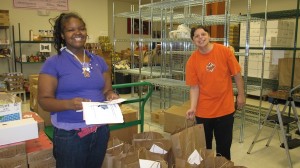
Latracies Dean and Niko Dzouropanos pack grocery bags for Moveable Feast deliveries.
on other goods. “No one wants to eat the food that we prepare and bring to them. That is, we all want to eat our own food that we make, that we season to how we like it, or that we want to eat—if today I want to eat roast beef instead of a three-bean chili, that’s what I want to do.…These are individuals who have such limited options before them that they really have no choice but to look to us to be their food provider. Ninety-five percent of our clients are living on Social Security disability, which is maybe $8,000 a year….They appreciate the food [we provide], they are grateful, but, like any of us, we like to eat our own food. Our clients are no different.”

Bonderenko says that critics miss the bigger picture on how individual health affects the strength of our communities. The ten treatment-conscious diet options that Moveable Feast provides to clients increase the potential that clients do well on treatment, stay healthy, and stay out of emergency rooms. “We have to pay attention to the extended impact [services like these] have on the economy,” reminds Bonderenko.

Though the funding issue has been resolved and reimbursement checks have started to come in, Moveable Feast is out the funds that they could have used later on in the year for services. “We have a waiting list of sixty people now that we could bring on to service if I had more funds. We don’t typically keep anybody on a waiting list for very long because I’ll make our own internal funds available to serve those individuals. What happened though is that I had to use those funds to carry use through July and August…right now, for lack of a better term, we’re living hand to mouth because we’ve pretty much exhausted our discretionary funds to be able to serve other individuals.”

It’s not as if Moveable Feast ever really relaxes about funding, though. The nonprofit also raises funds by seeking out private-sector grants. It recently received a $25,000 grant from the M•A•C AIDS Fund and a $10,000 grant from Bank of America, for example. It also participates in benefit events, like this past September’s Dining Out for Life, which recruited close to fifty restaurants in the Baltimore area as participants.

At present, Moveable Feast is looking ahead to the upcoming holiday season and its associated activities: a gift drive for families, holiday cards created by schoolchildren, a baking night that assures that every client receives a homemade pie for the holidays. “A lot of our clients are individuals who live alone or are disconnected from families,” says Bonderenko. “Actually for every holiday we try to do something for our clients, whether it’s Valentine’s Day, or Easter, or their birthdays. We try to do something just to let that person know that they’re thought about.” Not one day out of the year, but all year long.

For more information, log on to www.mfeast.org.

—Chael Needle

October 2011