Healing Words
Writer Chip Livingston talks to A&U’s Chael Needle About Stories of Survival
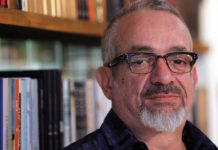
Photographed Exclusively for A&U by Gabriel Padilha
In “Fire and Rain,” the opening story in Chip Livingston’s recent collection of short fiction and essays, Naming Ceremony (Lethe Press), three road-tripping wanderers make it through the fire that has driven them from their campsite in a Florida forest. They’ve lost their clothes, ID cards; they find a creek—refuge. They’ve survived, but one is worse off than the others. He is resuscitated by one of his companions, mouth-to-mouth, or so he imagines. By the other, he is fed dessicated oranges that are revitalized by the water and willow leaves, that, if chewed, will unknot his stomach. Balance is needed, so the journey continues. Healing begins.
Healing as a means of survival is a theme that Livingston returns to again and again throughout Naming Ceremony, whether the theme is embodied by a cat surviving a plane trip, a stowaway in a suitcase; by friends and family members participating in an AIDS walk in honor of someone who has died; or by recurring character Peter, who navigates identities and invisibilities, whether he’s making sure turtle babies have a fighting chance or fending off a cute blond who gets under his skin or being honored by his elders at his naming ceremony for taking care of his mother and sister and for the power of his two-spirit nature.
Often the theme is braided with Native American knowledge and practices. Livingston sees it there, too. “That’s where I go for my understanding of things that I don’t understand,” he says. “When my first significant love, long-term partner, was diagnosed with HIV, the place I went was to Native healing traditions.”
His mother’s background is Poarch Creek, says Livingston, but he was raised as a Christian and Western medicine was the status quo. “Western medicine at the time—1993, 1994—didn’t have a solution. Traditional religion didn’t have a response. But I found that going to Native communities, my own and other communities that were dealing with HIV specifically, felt like a natural way to address a universal problem.”
Caregiving fuses with caretaking. Back when he was first affected by HIV, one of the first things he learned was this: “The Earth had acquired an immune deficiency. And that everyone was living with AIDS. And that’s sort of how I felt from the beginning. That this is all of our problem.
“So a Native perspective is where I go in all aspects of my spiritual, metaphysical [being],” he says, about life as well as storytelling. “The plot is the obstacle and the way I get through obstacles is: I think about how my ancestors or how my community would respond to it.”
“Ghost Dance,” the last story in the collection, revisits Peter, whose significant other, Elan (rhymes with healin’), has died of complications from a CMV infection. Elan has gifted to Peter his medicine bag, and Peter relies on his spirituality to help guide him through his grief, even as he chants for the return of Elan. The balance missing at the start of the collection—fire and rain without air or earth—is now restored as Peter dances in tribute to Elan on a windy, boggy patch of ground near his grave.
I posit that the medicine bag may signify that healing is something beyond a Western approach, with its insular focus on the body. “Right. Absolutely. I think that medicine bag in the story, a medicine bag that I have, personally, in my real, 3-D existence, does serve as a reminder to me in a very physical, real way—but also in the narrative way—that every issue is more complex and more global than we might initially take it for. And that even though the character Elan dies in the book, I feel that the book has a lot of healing in those stories and in that trajectory, through his illness.”
The stories featuring Peter and (sometimes) Elan are culled from a roman à clef, a novel based on Livingston’s experiences with his partner, Ash, and his progression through the illness. “So, I am Peter. Not everything that happens to Peter happened to me, but it largely follows a fictional path that I followed in real life,” explains the Florida native currently making his home in Colorado.
Peter says to Elan, after he has died: “You taught me the power of words.” But the power cuts two ways—it can help or hinder. “[Ash] always said, when we were early twenties, ‘If any of our friends die of AIDS it will be me.’ And I would say, ‘Don’t say that, don’t say that.’ And he’d say, ‘It’s my luck; if any of our friends die of AIDS it will be me.’ And he did. I don’t blame him for saying that—that was his perspective—but I do also think that he could have perhaps survived if he had chosen different words with which to talk about his illness.”
Livingston beautifully captures the power of words by highlighting the capacity of naming to both empower and to stigmatize and oppress. Peter’s sister Lana discovers someone has carved “Two Fags” into the bleachers as a way to demean Peter, who has been given the name, Two Wolves. Asked why he brought attention to the power of naming, Livingston responds: “In the recent years of minority groups finding ways to empower ourselves, our communities have taken back what the names mean, what other people are allowed to call us, whether it’s ‘queers’ or whether it’s ‘redskins.’ [We need to ask:]What are the effects of what people call us and what are the effects of the names that we call ourselves?”
Whether the names are meant to bully or endear, says Livingston, “I absolutely think that we live up and we act out the names that we’re
given or the roles that we are sort of forced into.…Even [the words] ‘AIDS’ versus ‘HIV.’ Even still, [and] as long as these diseases have been around, we give one set of initials a lot different power than we give the other.” For both of us, the debate over the use of “tranny” also comes to mind. “I think once we identify what is limiting us, we could totally shift that, just by changing the words.”
Or, as the characters in Naming Ceremony show, change can come by resisting the dynamics of identity and invisibility. In one story, Peter and Elan drive to St. Augustine for relaxation. A waitress, looking at an old-timey photograph of Peter dressed as a cowboy, tells him: “You could be an Indian.” Earlier, the photographer who shot Peter and Elan in costume assumes they are straight.
“I do think I write about mixed-blood Indians and Indians, in general, is because some of these people don’t even know we still exist. That there are millions of Native peoples in the U.S., at least 500 different nations. A friend in mine in Uruguay who is from California was like, ‘Oh, you know I just found out that there used to be Indians in California.’ And I was like, ‘There are still Indians in California!’ I think people still overlook that community.
“And I also think that in the gay community often we do the same with people who are infected with HIV. We don’t have to look at [AIDS] because it’s not in our face as much as it used to be; so we can just sort of pretend it doesn’t exist, I guess. I come from the South, where we tend to not talk about ‘unpleasant’ things. And I think that’s largely the way the world [is]; [it] also doesn’t like to look at unpleasant things. Or things that we think might be unpleasant.”
The power of words to make visibile those living with HIV/AIDS and to forge new, empowered identities is certainly deftly accomplished in Naming Ceremony. While gay men and their allies took up the cause of writing about AIDS in the eighties and nineties because the crisis saturated the LGBT community, says Livingston, nowadays he sees a wider embrace of the subject because we’ve seen how “it’s expanded to the whole world, how people of all walks of life are affected.” One of the pieces included in Naming Ceremony, “Anthology of a Spoon River AIDS Walk,” a reworking of the Edgar Lee Masters classic, speaks to this multiplication of voices. Drawn from Livingston’s own experiences, the poem is populated with the friends, acquaintances, family members, and lovers of one man who has died from AIDS-related complications. In turn, each of them explain “why they walk.”
“I felt that in some way it showed…that the illness of one person could affect a whole community, in this case how fifty-plus people were participating in something, and responding to and emoting on something really powerful,” says Livingston.
As the single poem in the collection, it’s the odd piece out, but Livingston doesn’t care. He loves the piece and he proceeds in writing with an openness to how any story wants to be told—poem, short story, essay, article. It makes sense that Naming Ceremony came together through this organic approach, as well.
Livingston has a simple manifesto—be true to the story and make it accessible so that, with any luck, the words can move people. He himself has long been enchanted with the power of words. As a young reader, he turned to storytelling not only for entertainment but also for “examples of coping.” As a college student, he discovered he could learn to be a writer—a thrilling, life-changing discovery—and promptly enrolled in one of Padgett Powell’s writing courses at the University of Florida. As a teacher (currently, he teaches in the low-residency MFA program at Institute of American Indian Arts, in Santa Fe), he hopes to nurture in others the craft at which he has excelled.
Alongside publications in numerous journals and anthologies, the award-winning writer has authored two poetry collections, Crow-Blue, Crow-Black and Museum of False Starts, as well as a chapbook, Alarum. He’s currently working on a memoir based on his decade of experiences—some of which pop up in Naming Ceremony—as an assistant living with an established poet, Kenward Elmslie. And the full story of Peter and Elan—that yet-unpublished novel—may one day come out. It would be a good reminder that journeys continue. After all, there’s more healing to be done.
◊
For more information, visit: www.chiplivingston.com.
◊
Chael Needle is Managing Editor of A&U.