Necessity: Mother of Prevention
Born Free Africa Counts Down to Zero Mother-to-Child Transmission by Stevie St. John
At its heart, it’s a simple problem with an elegantly simple solution.
An HIV-positive pregnant woman with access to care and medication can greatly diminish the chance that she will pass HIV on to her child during pregnancy, during childbirth or while breastfeeding. All she has to do is take one pill a day.
For that to happen, though, several pieces must fall into place. First, the expectant woman must have access to medical care, including HIV testing. Only if she knows that she is HIV-positive can she get the care she needs. Her healthcare providers must be trained in providing HIV testing and offering care for those who are positive. They must have access to testing equipment and, of course, to the antiretroviral meds themselves.
Without treatment, the risk of mother-to-child (or perinatal) transmission is some thirty-five to forty-five percent—compared to just less than one percent for those who get the needed care. And those children who are born HIV-positive face a fifty-percent chance of death before the age of two if they do not receive treatment.
Just one pill a day, taken by the expectant mother, would prevent the vast majority of these tragedies.
A mother in Khayelitsha Township shares her story with John Megrue, Chairman of Born Free Africa. Photo courtesy Born Free Africa
“HIV is a huge issue globally,” says John Megrue, founder and chair of Born Free Africa. “Having newborn babies born HIV-positive is really a huge challenge.” And the objective of a new generation being born HIV-free, he says, was “something that I thought was central to success” in the fight against HIV/AIDS.
Born Free Africa is a private sector-led initiative that partners with governments, donors, and nonprofits to provide funding, training and policy analysis in order to eliminate mother-to-child HIV transmissions in some of the most affected African countries such as Kenya, Uganda, South Africa, and Nigeria.
Megrue called Born Free Africa “a quite broad constituency thinking about it and trying to make a difference.”
The Problem of Perinatal Transmissions
In affluent countries, mother-to-child HIV transmissions have become quite rare. The Centers for Disease Control and Prevention says that perinatal transmissions in the U.S. have dropped by more than ninety percent since the mid-1990s, even though the number of HIV-positive women giving birth has increased dramatically.
But there are still many countries, the vast majority of which are located in Africa, where such transmissions remain a serious issue.
According to Born Free Africa:
• Worldwide, mother-to-child transmissions peaked in 2003 and have declined more than fifty percent in subsequent years
• 260,000 children were infected in 2012—an average of more than 700 per day
• In children, more than ninety percent of new HIV infections are the result of transmission via pregnancy, childbirth, or breastfeeding
• Nigeria accounts for more than one-quarter of newly infected children each year
• Twenty-two countries account for more than eighty percent of cases.
“It’s a systems problem,” Megrue says, referring to the barriers that must be overcome in order to halt mother-to-child transmissions. “We’re all working together to solve these challenges.”
Countdown to Zero Transmissions A health worker in Khayelitsha Township, South Africa, is interviewed as part of a documentary film project to explain mother-to-child HIV transmission. Photo courtesy Born Free Africa
The Born Free Africa Web site features a prominent countdown clock: the “countdown to zero transmission.” As of May 29, it stood at 581 days, with the green and white hours, minutes and seconds all marking progress toward December 31, 2015.
The specificity of the clock reflects an ambitious goal: halting mother-to-child HIV transmissions by the end of next year.
Why 2015? The deadline came out of Millennium Development Goals set by UNAIDS. Among ten “targets and elimination commitments” set by UNAIDS is the goal to “eliminate new HIV infections among children by 2015 and substantially reduce AIDS-related maternal deaths,” according to the 2011 United Nations General Assembly Political Declaration on HIV/AIDS.
The Millennium Development Goals were set in 2000, Megrue notes, with enormous strides made in subsequent years. In fact, Born Free Africa says that new HIV infections in children have declined by fifty percent between 2003 and 2012.
But there are still more than 200,000 annual transmissions worldwide, says Born Free Africa, with ninety-eight percent of those being completely preventable. But there are persistent challenges—funding issues, for one thing—that must be met before a generation born free can be achieved.
Navigating those challenges, Megrue shares, called for high-speed, fast-paced decision making—“and that plays to the private sector’s strengths.”
That’s where Megrue, chief executive officer of the private equity advisory firm Apax Partners, came in.
In 2011, the U.N. tapped Megrue, a longtime philanthropist with experience working in Africa (largely on issues related to poverty), to get involved. As a result, Born Free Africa was formed. In addition to Megrue, the organization’s advisory board includes CEOs and other power players from companies such as Chevron, NBCUniversal, J.P. Morgan, Johnson & Johnson, and GE Healthcare.
“Being part of something that the private sector can have such an influence in has been incredibly joyful,” Megrue says.
Making Prevention Fashionable Model Sasha Pivovarova and her daughter pose for a Born Free fashion campaign wearing Alberta Ferretti, who incorporated into the design an exclusive pattern print by Kenyan artist Wangechi Mutu. Photo by Robert Massman/robert@robertmassman.com
In Africa, Born Free Africa does work such as hiring talent and providing training for healthcare professionals. The organization also hosts visits from governmental and other leaders who come to see how mother-to-child transmissions are being combated.
In addition to its on-the-ground work, Born Free Africa puts its resources to work to raise awareness. For example, Megrue partnered with Vogue, Diane von Fürstenberg, Claire Danes, Liya Kebede and Wangechi Mutu to host a Mother’s Day Carnival in support of Born Free Africa; he called the event “a real crescendo of consumer awareness.”
Held in New York, the event featured performances by Ariana Grande and Idina Menzel. It also included family-oriented activities such as family portraits, cookie decorating, yoga, arts and crafts, face painting with M•A•C makeup artists, soccer with the New York Red Bulls, and basketball with the New York Giants.
There were many high-profile guests in the crowd, including actor Matt Bomer and designers Ivanka Trump, Vera Wang and Donna Karan.
Trump, Wang and Karan were also all part of a Born Free Africa initiative to raise awareness through a partnership with the fashion industry. Earlier this year, they and nineteen other prominent designers—all of them mothers—designed items for a limited edition Born Free Collection, sold via ShopBop.com. The collection’s array of tees, scarves, bags, pants, blouses, skirts and other items are based on the work of New York-based visual artist Wangechi Mutu, who was born in Kenya. Proceeds from sales of the Born Free Collection items benefit Born Free Africa, with a M•A•C AIDS Fund matching grant for up to $500,000.
“As a mother and as a fashion designer, Born Free is everything I believe in—taking care of mothers so they can take care of their children, which takes care of the world. That I could do all this through creativity was perfection,” Karan tells A&U via e-mail. “When you think about the vulnerability of new mothers and their babies, you’ll do anything to eradicate the transfer of HIV from one to the other.”
Karan says she was “completely inspired” by the Born Free campaign.
“Whenever you have a creative avenue to fight a real threat, it brings out the best in everyone,” she says.
By bringing out the best in everyone—from fashion designers to government leaders and private sector CEOs—perhaps Born Free Africa can build the awareness and support needed to reach its ambitious goal of wiping out perinatal transmissions of HIV.
Stevie St. John is a freelance writer in Los Angeles, where she serves on the board of the local chapter of the National Lesbian & Gay Journalists Association (NLGJA-LA).
The Price of Zero
Drug Policies in Former Soviet Republics, Like Georgia, Are Spiking HIV and HCV Rates by Larry Buhl
Georgia is facing the same problem as other Soviet republics: a surging rate of HIV and hepatitis C (HCV). Harm reduction advocates and NGOs have concluded that these surges have been exacerbated by government policies on illegal narcotics.
Russia, Georgia, and the Ukraine have very strict drug laws that mandate prosecution and punishment of users, instead of treatment or prevention. But Georgia has been particularly fierce in criminalizing drug use and “hunting” IV drug users.
To make matters worse, a lack of emphasis on treatment and education means people are unreachable by HIV prevention/harm reduction programs, according to Maka Gogia, Program Director for the Georgian Harm Reduction Network (GHRN), a group of non-governmental organizations that advocate the use of public-health policies to reduce drug abuse. “What contributes to the rise in blood-borne infections like hep C and HIV are harsh drug laws combined with the lack of free treatment programs,” Gogia tells A&U.
The GHRN estimates 45,000 drug addicts in the country. But there is only one detoxification center for all of them—a one-month free program located in the capital, Tbilisi, that can accept only two dozen people at a time. A methadone-substitution therapy program can accommodate 1,300 patients in eight towns across the nation. Beyond that, nothing.
“When you want to register for a treatment program, you must stay on a waiting list until someone leaves the program,” Gogia tells A&U. “During that time the police have a record of you being on that wait list, and that causes people to not sign up.”
While the government of Georgia has little money to invest in drug treatment and education, it is reaping a small fortune from cracking down on users. First-time offenders who use a narcotic without a doctor’s prescription can face a fine of 500 lari (US$280). That’s nearly half of the average per-capita monthly income in Georgia. On the second offense within the same year, the fine is 2,000 lari, (US$1,125) or one year in jail.
In 2007, the latest year for which data is available, drug fines brought in 30 million lari ($16.9 million) to the government of Georgia, according to a report by the Beckley Foundation Drug Policy Programme, a United Kingdom-based research center.
The crackdown started in 2006 when a “zero tolerance” policy on drug use was introduced by former President Mikheil Saakashvili. That policy shifted prosecution from drug traffickers to users, and no distinction is made between possession of drugs for personal use and for trafficking.
Proponents of Georgia’s zero-tolerance drug policy point to the drastic reduction in imports of heroin and opium. But it hasn’t stopped IV drug use. In fact, Georgia has the fifth highest rate of injecting drug use in the world, just behind Azerbaijan, Seychelles, the Russian Federation, and Estonia, according to the UN World Drug Report 2013.
With heroin and opium in short supply, Georgians who want a quick high are mixing cocktails called Krokodil, using readily available ingredients like gasoline, drain cleaner and cough syrup. Not only is this home brew highly toxic, it has made drugstores the new locus for cops to crack down on users.
“Very often you will see police standing outside the drug store looking for someone who ‘looks like’ an addict who has purchased these ingredients and shake them down for money,” says Paata Sabelshvili, a programs manager at GHRN. “This is how the government collects money. Drug users are more numerous, so the government will do the plea bargaining agreement with them. The government doesn’t count those users as human beings. It will lock them up, sell their houses and let them die in prison.”
Anecdotally police also have been known to take otherwise law-abiding people off the streets for random drug testing by urinalysis.
Sabelshvili says these policies drive drug-dependent people underground where they dramatically increase their risk of contracting HIV, HCV and tuberculosis.
“The rate of HIV in Georgia is still low, but it is increasing every year,” Sabelshvili says. “Now we see an increasing rate of HIV in the heterosexual population, and women who contract HIV now are mostly sex partners of injection drug uers. This is because Georgia has the most repressive drug policies in the world.”
Sabelshvili notes that they cannot collect used needles for a needle exchange program as many other countries conduct, because anyone caught with a syringe containing even a trace amount of an illegal substance risks jail time of up to fourteen years and huge fines. “All we can do is needle and syringe distribution,” he says.
A recent report on drug policy in Russia to the UN Committee against torture, by the Andrey Rylkov Foundation for Health and Social Justice in Moscow, underscores links between the harsh drug policies, lack of treatment for IV drug users and the rise in HIV and HCV, not just in Georgia but also in countries throughout the region, including Russia, Estonia, and Ukraine.
“Recent research showed that most (78%) patients with HIV/TB co-infection are drug dependent people,” the report states. In some cities in Russia, up to ninety percent of injecting drug users are infected with hepatitis C, it concludes.
A few in the Georgian government have taken notice of these disturbing trends. In December 2013 an intra-ministerial council chaired by Justice Minister Tsulukiani proposed increased funding for prevention and treatment and public information, and making the use of illegal drugs an administrative, rather than a criminal offense. Last November, at the signing of the EU’s Vilnius agreement on cooperative measures, Georgian Justice Minister Tea Tsulukiani pledged to “reallocate resources from the ineffective prosecution and punishment of drug users to effective prevention and treatment.”
Until legislation is passed, these recommendations for reform will remain on paper. The nation is scheduled to sign an agreement on closer long-term ties with the European Union on June 27. That signing is considered to be a big step toward eventual membership, but the EU has been silent on Georgia’s drug policies, and there is no telling when or if the nation will be invited to join the union.
For now, activists, like those in the GHRN, and their regional representatives will continue pushing the government to change, through petitions and protests against the drug policies.
In October of 2013 Gogia and her colleagues created a network of People Who use Drugs in Georgia (called GeNPUD) under the framework of the Global Fund Harm Reduction program. The network has created its statute, internal regulation, strategy, and annual work plans for the long and short term, she says.
“Our goals are first, change the drug laws, second, make the government increase funding for methadone programs, and third, promote the construction of rehab centers.” Gogia points to a large proposed rehab center in Tbilisi that the government has not yet built.
“People need to understand the growing number of people with HIV and hepatitis C here is not just a problem for drug users,” says Gogia. “It is a problem for the public health.”
◊
Journalist and novelist Larry Buhl writes A&U’s monthly Hep Talk column.
I AM Men’s Health
Philadelphia FIGHT Rethinks HIV Prevention, Shifting from DON’Ts to DOs with PrEP by Michelle Zei Stephen Handlon, Malcolm Dettiford, and Miles Hunt of I AM Men’s Health
Photographed Exclusively for A&U by Freedom G Photography
Don’t—the conversation around sex and HIV is full of these phrases: Don’t have sex, don’t have unprotected sex, etc. The negative connotation around HIV and sex can often make those who are sexually active and at high risk of contracting HIV feel ashamed. Silenced questions lead to less education and more risky sexual behavior.
Since its introduction to the public in 2012, the HIV preventive drug taken as pre-exposure prophylaxis, or PrEP, has shifted the conversation about HIV in a more sex-positive direction that encourages people: do live a healthy lifestyle, do examine your behavior, do embrace sexuality—and do take advantage of a new method of prevention to protect yourself and those you’re involved with.
PrEP is an HIV prevention system where people who are HIV-negative take the pill Truvada along with medical supervision and health monitoring. PrEP’s effectiveness increases with strict adherence. According to the iPrEX study, when MSM participants took Truvada consistently, their risk of infection was lowered by at least ninety-two percent. Another iPrEX study indicated that taking Truvada daily paired with condom use reduced risk by ninety-nine percent for MSM.
Philadelphia FIGHT’s I AM Men’s Health initiative has a special PrEP support group that’s been administering PrEP since January 2013. HIV prevention is especially needed in Philadelphia where HIV rates are five times the national average.
The program at FIGHT administers Truvada along with holistic health services and sex education. Staff members keep tabs on participants so they adhere to their medication and receive PrEP’s full benefits.
Antonio Boone, tester/counselor at I AM Men’s Health
I AM Men’s Health’s PrEP program is a model for effective outreach and distribution of the pill. The Youth Health Empowerment Project and PrEP group offer holistic healthcare services to young, gay minority men under twenty-five in Philadelphia. Rather than just learning about HIV prevention, participants are exposed to nutrition and mental health counseling, and a variety of activities that invite participants to consider their overall well-being.
The PrEP program’s medical director Helen Koenig, MD, broke down how PrEP works: “PrEP is a pill that someone without HIV can take to protect themselves from getting HIV. If someone taking PrEP on a daily basis comes into contact, either sexually or through exchange of needles, with someone who has HIV, PrEP can halt the ability of HIV to make copies of itself in the cells of the HIV-negative person’s body. This happens because the PrEP medicine, Truvada, blocks the activity of the protein that HIV uses to make copies of itself. Therefore, even though HIV-negative people can still become exposed to HIV, the HIV infection itself is aborted at a very early stage.”
I sat down with Oberon Wackwitz, Malcolm Dettiford, Luis Torres, Miles Hunt, and Stephen Handlon from Philadelphia FIGHT’s PrEP support group to talk about PrEP and how it’s influenced the way they view HIV.
Michelle Zei: How did you first find out about PrEP and what was your reaction?
Oberon: I already knew that pre-exposure prophylaxis existed but I didn’t know they were giving [it] out to people in at-risk situations other than people who are in current relationships with people with HIV. So I was here with my gay brother, if you will, and he was already in the program and I asked what he was taking and I started asking more questions about how it works and it seemed very promising to me so I signed up and started off without any initial side-effects. I did stop at first but, when I started back up again, I had a few [though] after a week they were gone. It was pretty cool to get involved. Malcolm: I heard about it through a friend. I found out about it about a year ago and I’ve been taking it ever since then. The effects I experienced weren’t too rough but it’s just fine. Now I know I can have sex with random men with protection, and my risk is lower. Noel Ramirez, program coordinator at I AM Men’s Health
Luis: When I first heard about PrEP I was interested in it. I didn’t really know what was going on so I just kept coming every Monday to see how it works and what the benefits are of taking it. I just feel like it’s a great thing to offer to people with a higher chance of contracting HIV because they have risky sex sometimes. Miles: Caitlin told me about the program. At first, I was like I’m not doing it, it’s too much paperwork. But the more she explained it, she told me it would lower the risk and it’s free so I took it home and read it. I came back the next week and signed up for it. Caitlin said PrEP lowered the risk by ninety percent so I said, okay, if I’m going to have sex with males that may or may not have HIV, I should take it.
At first it made me sick; then I thought about it in the long run, and it gives me a better outlook on life and lowers my risk. It lets me know I can still live my life taking it and I can talk to people who are HIV-positive. I have a sense of happiness that other people are taking it and I’m not the only one. The support group lets me ask people if they’re going through the same thing.
How did you grow up viewing HIV?
Oberon: When I was younger and I didn’t know about PrEP, I thought HIV was the end of the world. You would take medication and your sex life was gone. There was this incredible social stigma, you wouldn’t be able to connect with people as you normally would. To an extent some of this is true, but my view was very unrealistic and it was a really scary thing for me. Malcolm: Someone in my family has it so I was like, oh my god I’m going to get it. When I was younger it scared me, but now it doesn’t scare me as much. Even though I wasn’t sexually active I was scared I could contract it because I didn’t know anything about it. Then, I turned nineteen and learned stuff about it. I felt like I was bound to get it because I’m a gay male and everyone is always saying that I’m going to get it. Miles: I was scared, I thought if I caught it I would die instantly. I heard about it but it didn’t really affect my life. When I moved to Philly I knew I had to be careful because there’s a [large] population of people with it. Stephen: In tenth grade, I watched the Philadelphia movie. It was kind of weird because there weren’t any out gay people in my school so that was like the only depiction of gay people, which in a sense was misleading. I got more educated when I was in college through classes and my own research. Even when you get tested, it’s like, okay, good, you’re negative, but they don’t talk to you enough about lowering your risk.
Has PrEP changed the way you view HIV?
Oberon: I can take my sex life back into my own hands so I don’t have to feel afraid if I’m in a situation that’s considered Caitlin Conyngham (left), administrative manager at the Youth Health Empowerment Project, and Dr. Helen Koenig, who acts as medical director of I AM Men’s Health
risky, even if it’s with a condom. It’s also opened my eyes toward research around HIV. It’s amazing that since the HIV/AIDS epidemic we’ve gotten as far as we have. It’s very important because a lot of people within the gay community are not using condoms, period. This gives us [as PrEP users] the upper hand because regardless of how we view unprotected sex morally, the fact is that [some people are having unprotected sex], whether we say it’s wrong or right. We should be proactive and that’s what PrEP does. This at least keeps people from contracting one disease that’s very life-altering and incurable. On a larger scale, if everyone was taking this drug, HIV rates would go down significantly in our community. Luis: Since I started taking it, [and] of course I’m worried about [HIV infection], but I feel my chance is really small. Since I’m on this medication I feel like I might not be able to get HIV but I still should worry about other things as well. Stephen: Using it has changed how I think about HIV because I feel like in public health there’s almost too much focus on things after they happen; there isn’t as much focus on prevention. I guess it’s partly just human nature to think of something after the fact, but I think if it’s more widely available it would be better economically as well than to treat people with HIV individually.
If you don’t use condoms consistently and correctly, it’s basically like not using them at all. Being here, a lot of teens aren’t using them consistently and correctly. It’s really hard or people just aren’t doing that. It’s better to acknowledge that and deal with it.
What are some misconceptions or concerns that people have about PrEP?
Oberon: I will say that honestly that Truvada alone, without any support or programming like this, [may significantly impact people’s views about the importance of other prevention tools]. It makes people more comfortable with having [condomless] sex because they’re thinking, ‘I can’t get HIV.’ But they fail to recognize that they can get other diseases.
The beauty of a program like this is that it’s a guide through that process—yes, we’re going to get the drug but also other means of prevention for other STDs. We learn about other diseases and get tested for them which reminds you that Truvada can keep HIV at bay but there are other diseases—this is the reality. Sex can get messy and you need to take care of yourself. PrEP is more than just a pill; it’s a whole system.
It’s very odd that people have this adversity to taking the medicine. A lot of people don’t like the idea of taking it. I was talking to some people today and they were very iffy about it; they were questioning it heavily almost like it’s poison. One person was saying it’s an excuse to not wear condoms. People aren’t wearing condoms anyway—that’s the point; that’s why PrEP prevents [at least] HIV [among those who go condomless]. It’s crazy that people have this view of it. Why is this a thing, especially amongst poor, minority people that are at higher risk? They have this aversion to medical treatments that could be potential lifesavers. I don’t understand why it’s like that; I think it’s something that seriously needs to be looked at. It’s a big issue because how can you lower the overall rates in Philly amongst higher risk populations if they’re afraid of it? Luis: When I bring it up to my friends, a lot of my straight friends, they ask if it’s been tested. Like, it’s FDA-approved—of course they had to test it on people. I feel like people judge because they’re oblivious to the drug but I think people should know more about it. Doctors should tell people and if doctors don’t know they should be informed as well. I try to give PrEP a good name because it benefits you in the long run. I feel like it would be good for everyone.
The dedicated staff at I AM Men’s Health have seen firsthand where other HIV prevention tactics fail or fall short. In particular Noel Ramirez, LCSW, MPH, program coordinator at I AM Men’s Health, noted the danger of relying solely on condoms for HIV protection.
“With gay and bisexual men, there’s a large context of shame that informs their identity formation. PrEP really helps dismantle that. We’re often hard-pressed to push the condom conversation that silences the conversation that might make us uncomfortable. This forces us to get to the core and stigma around gay sex. That kind of stuff isn’t addressed when you give a kid a condom and say ‘Have safe sex, always safe sex!’ Clearly there’s a disconnect because our incident rates, particularly with this population, continue to rise every year,” Ramirez said.
Despite PrEP’s accessibility (it’s covered by all insurances including Medicaid and Medicare and available directly from Gilead Sciences, Inc., with a prescription), there are still obstacles inhibiting people from using PrEP.
“Folks who would benefit most from PrEP—we know the highest group for acquiring HIV is young MSM of color—are the least likely to be in medical care at all. These are folks least likely to have primary care and primary care providers have the least experience working with them. We know that clinicians and physicians are notoriously bad at assessing who is at risk. As far as I’m concerned, anyone who is sexually active is at-risk. It may not be a sentiment shared by many providers unless you’re using drugs or have many sexual partners, but other people are also at-risk,” Dr. Koenig said.
PrEP also empowers people to take more control of their sex lives and remove some of the stress that accompanies sex, according to Caitlin Conyngham, the administrative manager at the Youth Health Empowerment Project.
“We really believe everyone should have the choice to access PrEP the same way you talk to people about their risk of pregnancy about birth control. We know that PrEP works nine times out of ten to prevent HIV if you take it at the same time everyday. That can be a game changer in how you want to have sex. I tell people you shouldn’t be terrified every time you have sex. This allows you to take that fear off the table a little bit. It puts it in a different context because you’re not making the decision when you feel emotional or aroused. You’re making the decision over breakfast or dinner and we all make better decisions when we don’t have all the other mess on the table,” Conyngham said.
In May 2014 the CDC published clinical practice guidelines for PrEP, helping more clinical practitioners understand PrEP as a highly effective HIV prevention strategy. The guidelines advise clinicians how to determine who is considered at risk for contracting HIV and could potentially benefit from PrEP. MSM and people in relationships with HIV-positive partners are not the only groups considered at risk, a reminder to the public that HIV is not an issue confined to a specific community but also includes heterosexuals that have unprotected sex with partners of unknown HIV status. These guidelines begin to recognize the changing reality of what it means to be “at risk” and invite broader discussion and participation surrounding HIV prevention.
Michelle Zei is a freelance multimedia journalist. As a journalism student at Temple University, she developed a passion for grassroots organizing and community media. Her interests include HIV/AIDS, the Palestinian-Israeli conflict, millennial activism, and immigration. She believes in the power of the pen and the Web to educate and unify communities. Follow her on Twitter @michellezei.
Brave New World
One Man Navigates the World of Sex and Love in the Age of PrEP and PEP
My boyfriend likes to give, and I like to receive, so it’s kind of perfect—if perfect is something two people can be. We’re the classic top-and-bottom relationship, and it’s kind of amazing. We’ve been dating for three months and things are going really well. We laugh at each other’s silly jokes; we stay up late watching Scandal on Netflix in our underwear; and we have deep, winding conversations about life, religion, and love while eating pizza and French fries. It’s the kind of relationship I have always hoped for… But though we seem compatible in more ways than most, we have had sex only three times. Three times in three months! For me, that is a problem! Sex is kind of a big deal. Now, normally, I would have a long exhausting conversation about how “I need to be emotionally validated by sexual intimacy,” and how “I expect our physical relationship to involve more than just kissing and handholding in the park,” but the situation is a little different this time because I’m HIV-positive and he is HIV-negative.
We are serodiscordant. Having different viral statuses makes sexual interaction a little more complicated—but it’s 2014 and we are both adults, so we know the drill: Condoms are the answer (at least that’s what they tell us). Now, to be honest, I’m thirty-seven years old and I’ve been HIV-positive since I was twenty-one. And because I usually only date other positive guys, it’s been at least ten years since I’ve had to use a condom. He’s fifty-one and only puts his penis in people who he says “I love you” to, which greatly reduces his number of sexual partners, so he hasn’t had to use a condom in just as many years. So needless to say, our first attempt was a royal flop! We fumbled with the little rubber instruments like we were monkeys doing math problems! It was frustrating and sad. The condoms kept slipping off, neither of us could maintain an erection, and we spilled lube everywhere! It was a disaster. But we were determined to be good boyfriends, so the next week we buckled down and tried again. We got the lube ready, bought some fancy extra-thin, extra-sensitive, extra-expensive Trojans that were guaranteed to feel “Just like skin,” and it worked (kind of).
We got it in quickly, finished even quicker, and high-fived each other that we had done the impossible! It was efficient, practiced, and safe. We were very proud of ourselves.
Now, this is when it gets interesting. By the third time we were professionals! We had discussed pre-exposure prophylaxis (PrEP) and post-exposure prophylaxis (PEP)—and the fact that I was undetectable and that he was a top, and that we were partnered, monogamous, and in love (because love is kind of a big deal). We began negotiating risk in a way that had not been possible just two years before! By the third time we had read articles and shared the results of research studies that found that serodiscordant couples where the bottom was HIV-positive and the top was HIV-negative were at low risk, and if the HIV-negative partner was on PrEP it reduced their risk to an even lower level than the use of condoms could, and the most promising said that if the HIV-positive partner had fewer than 200 copies of the virus in his system, the risk was reduced to a nearly zero-percent probability of transmission. We were living in a brave new world! And that night we had sex without a condom, and it was perfect and amazing! It was musical and rhythmic and intimate, and the air in the room was alive with our laughter and our moaning and the friction of our skin. And it was beautiful. We fell asleep in each other’s arms dreaming of a wonderful future together.
But in the morning he was afraid. In the morning he asked me if he had been exposed. And even though the new science says that he is safe, and that what we did is less risky than using condoms, I still felt guilty and ashamed for not using one, so I told him to go see his doctor.
He’s been on PEP for three weeks now, and we haven’t had sex since.
◊
Corey Saucier is an artist and writer living in Los Angeles. He is a Lambda Literary Fellow in Fiction and Non-Fiction and is currently penning his first novel. His musings and wanderings on Love, Life, and Non-sense can be found at www.justwords.tumblr.com.
Stepping Back
Michael Urie Discusses the Importance of the Arts in Teaching Life’s Lessons by Dann Dulin
Photographed Exclusively for A&U by Annie Tritt
My favorite Pandora station is ‘Herb Alpert and the Tijuana Brass’!” boasts Michael Urie with stirring delight. He then air trumpets a few notes from the 1965 hit, “Whipped Cream.” An old fan of The Four Seasons, Neil Diamond, Karen Carpenter, Mama Cass, and Barry Manilow, he’s even a self-proclaimed “Fanilow.” “I am not of my time,” he reveals.
From the living room of his publicist’s Hollywood Hills home, an indefatigable yet somber Michael carries on. “I consider myself lucky to be alive today,” he says. “I might have been promiscuous and would have been in the middle of it all—in the middle of it! And had I not
died during that time, I probably would have witnessed others dying.” Gloom sweeps across his boyish face.
On a brief visit to Los Angeles from his New York residence, he’s set to embark on a national tour (first stop, Chicago) of his award-winning one-man off-Broadway comedy, Buyer & Cellar. Michael plays many characters in this Jonathan Tolins-penned account of a jobless actor who finds work in the basement mall of Barbra Streisand’s Malibu compound. He even portrays The Diva herself.
Michael’s last New York performance was in March. “Being on stage by yourself is scary, but it’s a blast,” he concedes. “I still experience the terror. I ask myself, ‘What if tonight’s the night that I forget it all?!’ It’s not easy, but it’s become manageable.” As far as he knows, Streisand has never seen the show and he’s curious if she’ll appear in the audience when the show comes to Los Angeles this summer. “Of course she’s aware of it but I don’t particularly want to…invite heeeer, ” he says cautiously with a lilt. “She doesn’t need to see it.” He ponders for a moment. “But I think she’d like it if she saw it on her own terms. I don’t know if it’s fair for her to watch it with an audience. Maybe she would like a command performance or a video.” He wonders.
Ensconced in a high-back wood-armed King Henry VIII chair covered in a grayish classic music-themed pattern, this afternoon Michael is friendly, dapper, and bouncy. His overall presence constitutes a childlike spirit of wonderment. He’s not unlike Marc St. James, the popular character he played for four seasons on the celebrated sitcom Ugly Betty (2006–2010). Urie was originally to appear in just one episode, but his talent and chemistry with co-star Vanessa Williams won over the producers, and he became a series regular. He rocketed to fame.
During the filming of Ugly Betty, the writer’s union went on strike and production shut down. Not one to remain idle, Urie liberated a passion. He made a documentary film about his high school Speech & Debate Club, where he won a national championship in 1998. Thank You For Judging chronicles the tumultuous journey of several students who compete intensely in a State tournament. Co-directed by Sean Fornara, Michael did not intend to appear in the film, but his own success gives relevance to an event that’s close to his heart. The opportunity of playing multiple characters at these tournaments laid the sturdy foundation for Urie’s acting ability. The touching, absorbing film is now on DVD. During our time together, Michael expresses great pride in this project.
In 2009, Michael performed Off-Broadway in The Temperamentals. For his portrayal of Rudi Gernreich, one of the founders of The Mattachine Society, a gay activist’s group in the closeted fifties, he received a Lucille Lortel Award for Outstanding Lead Actor. “One day the playwright phoned to tell me that I was ‘too Ugly Betty’ at a particular performance, after I’d been shooting Ugly Betty all day,” Michael giggles.
In 2012, he debuted on Broadway in How To Succeed In Business Without Really Trying, appearing alongside Nick Jonas and Beau Bridges. Next, Michael returned to the tube in the short-lived sitcom, Partners, from the creators of Will & Grace.
The publicist’s dog begins to bark in the hallway. Michael, dressed in semi-snug jeans and a long-sleeved, thin ash-grey hoodie, picks up a ball and tosses it. Tallulah (named after the feisty headstrong actress, Tallulah Bankhead) proceeds to chase it. The publicist appears to politely escort the Polish Lowland Sheepdog to another room. Just last year Michael, sadly, lost his beloved dog, Sprouts (Tallulah and Sprouts were playmates), and now has a Chihuahua/Boston terrier mix named President McKinley, which he calls “Kinley.”
Active in the HIV/AIDS community, Michael shares that his focus and his on-going mission is to keep the epidemic center stage. “There’s no way that people my age and younger can fully understand the depth and impact of the beginning of the AIDS crisis,” he tells me, finishing a fresh orange and then pitching a couple of peels with an overhand throw into a drinking glass on the coffee table. “That’s why it’s so important to keep this time in our history alive—obviously, it’s not just an LGBT issue—but especially now that the LGBT movement is so big and moving so quickly.”
Hailing David Mixner [A&U, July 2002] as a hero of the epidemic, Michael cites the author and civil rights activist: “‘We lost a generation of storytellers.’ That to me is part of the reason why many of these seventeen-year-olds don’t know about AIDS, because the stories are not being told. It’s partially our fault as a society for not seeking out those who were there and listening to their stories. Of course, the sad truth is that a lot of them are gone.” He folds his arms and lowers his head. “And some of them don’t want to talk about it because they don’t want to relive it. I understand. So it’s our responsibility to carry it on.”
The arts are the finest educational tool, he urges, mentioning the recent airing of The Normal Heart on HBO. (A few years ago, he saw The Normal Heart on Broadway twice.) “So much of what I know about AIDS is from the theater,” he acknowledges. As a teen in Plano, Texas, Michael was deeply impacted by Tony Kushner’s Pulitzer prize-winning play, Angels in America. “I really fell in love with it!” he says with exhilaration. Just then, in another room, the phone rings. Clatter can also be heard throughout the house (a crew sets up for a photo shoot to follow), but Michael stays centered and authentic.
“When I was fourteen, my sister, who’s seven years older and a lesbian, took me to a gay bookstore in Dallas. I had heard of Angels in America through Speech & Debate [in high school], so I bought it, and read it.” Michael’s history lesson of HIV/AIDS has been through plays and films like Philadelphia, Silverlake Life, and Longtime Companion.
As a teenager, Michael’s bedroom was plastered with Batman posters that depicted the crime fighters confronting The Joker. Jack Nicholson’s portrayal of the villain inspired Michael to pursue an acting career. At nineteen, he was accepted to the Julliard School and he moved to New York. He became a member of the school’s Group 32, joining fellow student, Jessica Chastain. Several years later he received the John Houseman Prize for Excellence in Classical Theatre.
Following Ugly Betty, in 2011 at age thirty, Michael landed a childhood dream. He was cast in the Off-Broadway revival of Angels in America, playing the haunting lead character of Prior Walter, a gay man battling AIDS.
It was a mammoth undertaking. Urie endlessly researched the early years when the virus was rapidly spreading across the country, burying himself in the culture and climate of the times. He watched videos, read profusely, and sought out those who lived through the horror. He lost weight and applied pale makeup. “Playing that character was totally terrifying—especially dealing with the angst of those times. It was heavy for my thirty-year-old brain. I mean, just trying to imagine what these guys went through…,” he pauses, rigidly swallowing, then continues, “… who had AIDS….Terrifying. Just imagining what my life would have been like if I had contracted the virus….” There’s a moment of weighty stillness, then Michael flashes those “googly eyes”—a self-described term.
I break the silence and ask Michael if he was ever promiscuous. “Not really,” he admits tentatively. “But had there not been AIDS, I might have. It’s so hard to know.” He crosses his leg, grasps his ankle, and twittels with the shoelace of his stylish black urban boots. “I was going from bed to bed but I was always safe—totally safe. I always have been aware of the risks.”
For nearly six years, Michael has been in a monogamous relationship with actor and writer Ryan Spahn, who is the same age, and Urie asserts that they both get tested regularly. Over a span of two years, mutual friends, separately, tried to set them up with a date when they both lived in Los Angeles. It never happened. Eventually, they both relocated to New York and, coincidentally, so did one of the friends. “One day, the friend was very late to meet me, and Ryan was early to meet her, so we were left to our own devices. The rest is history,” he chuckles. This was Halloween. Michael humorously brings his hoodie up over his head then quickly doffs it, blazing that alluring smile.
The couple often collaborates professionally. Last year Michael directed Ryan in the film, He’s Way More Famous Than You. Ryan also co-wrote the screenplay. The cast included Ben Stiller, Jesse Eisenberg, Vanessa Williams, Natasha Lyonne, and Mamie Gummer. Last month they did a reading of The Last Sunday in June, by Buyer & Cellar playwright Jonathan Tolins at Chicago’s About Face Theatre, whose objective is to enlighten and empower others about LGBT issues. Michael chose a Monday night when Buyer & Cellar was dark.
Urie has been active in Broadway Cares, appearing in its fundraisers, Broadway Bares, Broadway Backwards, and Easter Bonnet. He’s also participated in AIDS Walks in Los Angeles, San Francisco, and New York. “I always leave AIDS Walks standing a little taller and misty. I’ll never get tired of hearing that song someone usually performs at the start of the Walk—‘You’ll Never Walk Alone,’” he remarks, adding, “Even though people are living longer with HIV, every year we get more people doing the Walk.” He’s plainly smitten with the event. But it wasn’t initially so.
Michael Urie (right), with Michael Jay Ryan, in The Temperamentals. Photo courtesy M. Urie
During his run on Ugly Betty, he was invited to speak at the Los Angeles AIDS Walk opening ceremony, though decided not to walk. He notes he wasn’t fully aware of the power of the event until later. “It hadn’t touched me yet. I didn’t realize I could be a part of the solution. It seemed impossible to me that I could make a difference,” he recounts.
“I’m thrilled to be asked now, because I feel that I can be of service. It’s so important for me to give back.”
Some of Michael’s friends are HIV-positive. Over the years, some did not survive. His steel-blue eyes unexpectedly squint and his nicely shaped eyebrows furrow. He looks consumed. “So many people my age are truly less aware than I am…,” he notes. “I’ve been lucky enough to be immersed in it thanks to the theater.” He lightly grins, bringing our conversation full circle. Recently, Michael read a modern play, still at risk, by Tim Pinckney, about how all of us can still be infected. “It could be a companion piece to The Normal Heart,” he explains. “It’s about remembering the pioneers of the AIDS movement. So many of them, like Larry Kramer, got fired from their own organizations, because the organizations wanted to become mainstream. Consequently, they ceased being radical.”
Michael also did a workshop production of still at risk, playing the character of a young man who never lived through the beginning of AIDS, very much like Michael himself. “It was interesting for me to get involved because I’m playing a guy who thinks he knows everything, and I’m a guy who practically knows nothing.”
As he speaks, Michael oddly rests his arm atop his head stroking through his generous cleancut acorn-colored wavy hair. A playful habit, it calls to mind a high school student intently concentrated and enraptured with what he’s doing. “It’s impossible for me to relate how it was back then at the beginning of the AIDS crisis,” laments Michael, leaning towards me. He’s wide-eyed and his personality is as fresh as linen drying on a clothesline in the afternoon sun. “Even knowing what I have learned, and pretending [acting] to have gone through it, it’s impossible for me to really know what… it’s…truly… like.”
Maybe so.
However, through his compassionate work, Michael remains strident in his efforts to alert others about HIV/AIDS, keeping the past present and always marching to a beat of his own rhythm.
◊
MICHAEL, CENTER STAGE What is Michael’s favorite? Food: Steak. Film:Arthur. Color: Orange. Clothing: Jeans and a Tee. Sitcom:Seinfeld, and NewsRadio is a close second. City: New York. Physical asset above the waist: Hair. Physical asset below the waist: [He laughs, thinks, then answers.] Feet. Dancers tell me I have an excellent facility. Let me show you my pointe. [He stretches, arching his foot.] I can’t dance to save my life though… Actor: Jack Nicholson. Actress: Sally Field.
URIE’S UNIVERSE
Have you ever been starstruck?
Yes! Meeting Martin Short, Tom Hanks, and Lily Tomlin.
Share your favorite beauty tip.
I have a very strict shaving regimen. I like to shave in the shower. I wash my face then apply pre-shave lotion, shaving cream, then I shave, shave, shave, shave, shave. Next I post-shave with liquid I moisturize. I have sensitive skin.
What do you fear?
I fear sharks and the ocean.
What’s the one thing you find attractive about your partner, Ryan?
His smile.
How many times during the day do you look at yourself in the mirror?
[he screams] … a lot!
What’s your foodstyle?
I’m a very plain eater when I’m acting in a play because I don’t want to be thinking about my digestion on stage. When I’m not in a play, I eat whatever I want. I am not a foodie; I like to eat a lot of food.
What do you dislike most about yourself?
I wish that I could practice what I preach. Even though I am aware of my flaws I still let them get me down.
What do you do when you get down or depressed?
I get gloomy and I try to put on happy music like Herb Alpert or watch a cheesy action movie.
What happens after we die?
That’s probably it. I don’t think much happens. [He looks away.] I would be thrilled if something did!
Where do you go to recharge your batteries?
Palm Springs.
What kind of undergarment do you wear?
Tightie-whities.
What’s your pet-peeve?
The little things, like making the wrong decision in traffic or getting in the wrong line at the subway or grocery store.
Complete this sentence: “I know it’s going to be a good day when…”
I wake up before I’m supposed to and I’m fully rested.
What celebrity would you like to have wild animal sex with?
Hmmm, good question. I never really thought about it. I’d say, someone like Michael York when he was in Cabaret.
Who would you like to meet?
Barbara Streisand.
Making His Marc Michael gives a brief reply about people who have intersected his life:
Brandon Routh: Lovely. America Ferrera: Brilliant. Betty White: Dirty. Judith Light: A vision. Christine Baranski: Cool. Christopher Hanke: Spark. Randy Harrison: A mentally balanced Tennessee Williams character. Alec Mapa: Hysterical. Nick Jonas: A good guy. Scott Wolf: Ageless. Jackie Hoffman: One of a kind. Jessica Chastain: Star. Michael Musto: Legend. Vanessa Williams: Class. Patti LuPone: Doll. Barbara Walters: The other Babs. Carol Kane: Cute.
◊
Stroll by to see Michael in Buyer and Cellar at The Mark Taper Forum at The Music Center in Los Angeles through 17th August 2014.
Sally Field Can Play the Transsexual: or I Was Cursed by Polly Holliday
by Leslie L. Smith
A PressLess Book
Reviewed by Sally Hessney
In Sally Field Can Play the Transsexual, main character David Mathews’s memories are so ephemeral he deploys a mnemonic device to hold onto them. He plays back memories in his mind’s eye as scenes from Hollywood movies or episodic television shows, recasting the people in his life as actors. This device allows him to catalog memories for easy retrieval as if they were movie reels in canisters on an “imaginary shelf.” Without this device, he would only be able to remember the bare facts about his life.
David is a prostitute who lives in New York City. For reasons he cannot fully explain, he always sees himself as Sally Field, the spunky actress from Norma Rae and Murphy’s Romance. He replays his memories of running away from home—hitching rides in big rigs and giving blowjobs to truck drivers—as scenes from Smokey and the Bandit. When he returns home to Arkansas, he meets a compassionate transsexual nurse who personifies Sally Field’s down-to-earth warmth and wisdom, and he realizes that the mnemonic device he uses as a crutch is constricting his life.
David is a strong, athletic, and single-minded swimmer, but, as a man, he is drifting through life. When the book opens, he is dividing his time between a beach house in the Hamptons and an apartment in Manhattan. He is still turning tricks while living off of a trust set up for him by a friend, Robert Jeffers, who died of AIDS in the mid-1990s. He has begun having bareback sex with strangers for fun and money. He has it with one-night stands and with clients who are willing to pay more for condom-less sex. He doesn’t want to know his HIV status but assumes he is positive. He wears condoms with men who report themselves as negative but doesn’t wear them with men who report themselves as positive.
Ironically, David came of age in the early 1990s and was indoctrinated into a belief system that precluded unprotected sex. In 1992, David’s friend, benefactor, and mentor, Robert, interviewed him and other rent boys for a magazine article about safe sex. All of the interviewees, including David, are quoted as saying “that no amount of money” could entice them into having unsafe sex. Now, David confesses he finds bareback sex to be extremely pleasurable and engages in it as a way to truly connect—skin-to-skin—with other men. It is at this juncture that Robert’s ghost shows up to confront him about his risky behavior, to guide him through a family calamity in small-town Arkansas, and to help him recover the memories he has suppressed for most of his life.
Author Leslie L. Smith
Author Leslie L. Smith draws a parallel between David’s forgetfulness and the amnesia that has beset the gay community in regards to the AIDS crisis. No doubt, there is a gulf between the anger and activism of yesteryear and the apathy of today. But times have changed. David tells Robert, “Yours was the last funeral your friends attended.” Young gay men are coming of age during a time when HIV is an increasingly manageable disease through drug compliance. Pre-exposure prophylaxis (PrEP) and post-exposure prophylaxis (PEP) are effective HIV-prevention tools. And bareback sex is a growing trend—albeit a controversial one—among men who have sex with other men. It is only after David’s memories come flooding back that he can come to grips with the changes that have taken place since Robert’s death without feeling paralyzed by heartache, shame, guilt, and fear, and finds his voice as an ardent and eloquent activist who is capable of envisioning a strategy for ending HIV and AIDS in his lifetime.
◊
For more about Leslie L. Smith, including the author’s insightful blog posts, visit: www.sallynovel.com.
◊
Sally Hessney is a program assistant at a nonprofit organization, where one of the educational missions is to educate teenagers about the dangers of binge drinking, prescription drug abuse, distracted driving, STDs, and other consequential issues.
Better Days
A new study looks at changes in mood as they relate to risk & protection by Chael Needle
“Happy” is not just a number-one song by Pharrell Williams. Nurturing that emotion across its day-to-day changes may be an essential part of protecting your own and your partners’ sexual health if you are a sexually active gay, bi, or same-gender-loving HIV-positive man, according to a new study.
Led by Patrick A. Wilson, PhD, associate professor of Sociomedical Sciences at the Mailman School of Public Health, Columbia University, and recently published in the journal Health Psychology, the study shows that sexual risk, defined as unprotected anal intercourse, among participants was lower when participants felt greater well-being than usual (happier) and less depression than usual. Conversely, sexual risk was higher when depression was greater than usual (sadder) and well-being lower than usual.
Wilson and his team sought to assess the mental health of HIV-positive MSM in relation to sexual risk behavior in a more dynamic way than previous studies or interventions had. Previous studies have suggested a weak association between depression/emotional wellbeing and sexual risk-taking, with some even surmising that depression may even reduce risk. For the most part, says Wilson, “we haven’t looked at how mental health plays out over time, how it changes over time, and how it changes—in somewhat quick and rapid fashion—over time.”
That is, while a static assessment of individual mental health may provide accurate information, it is information locked into that particular moment in time. It’s like one of those photos they take of you on a rollercoaster. But, instead of a single snapshot of anguish or euphoria, what if you had streaming video of that adventurous ride of good days and bad days, better weeks and worse weeks, called Life?
With this methodology, researchers were no longer restricted to looking at the relationships between typical emotional states and risk in general; they were able to trace how fluctuations in moods relate to fluctuations in sexually protective practices. So it’s not just about feeling depressed, but feeling worse; not just about feeling happy, but feeling better. Notes Wilson: “It’s not that when I’m more depressed I’m risky; it’s also when I’m happier I’m more likely to protect myself and my partners.” It’s not the mood, per se, but the change in mood that we might also attend to. Through this lens, the world is not so easily divided between those who are depressed and those who aren’t; or, those who are “safe” and those who are “risky.”
For this assessment, then, the researchers asked participants to complete a six-week Internet-based survey. (The 106 participants were HIV-positive MSM living in New York City. The sample was racially diverse: 51.9 percent of the participants African-American; 25.5 percent were Latino/Hispanic. Almost seventy percent reported an income of $20,000/year or less. Eighty-one percent reported multiple partners. A little more than forty percent had undetectable viral loads.) For each week participants reported sexual activity, they were asked about sexual behaviors, and HIV status and gender of their partner(s). During Weeks 1, 3 and 5, participants’ depression and well-being were measured according to well-established tools.
As assessments of emotions in flux within the mental health field are often tied to major life-event triggers (illness, death, the end of a relationship), the day-to-day life stressors that may be just as impactful on mental health are often glossed over. Says Wilson, the study brings to light the fact that “just as we change environments, go in and out of different social contexts, there are different influences that can tug and pull our wellbeing and mental health such that we may be really happy one day and really sad another.”
Wilson and his team sought to assess these subtleties to create a more fine-tuned portrait of mental health, in this case among HIV-positive MSM, who may experience “higher levels of those stressors than other populations.” These stressors, in turn, may be compounded by the stressors that come with lower socioeconomic status and/or navigating life as an ethnic minority, says Wilson, who hypothesizes that these factors may help explain the observed fluctuations in mental health and mood.
“I would conjecture that many of those individuals who have means, or at a higher socioeconomic status than the guys we spoke to, may not experience much in terms of mood fluctuations. I think all people have good days and bad days, right? And moments of ‘Oh I’m feeling super-stressed right now,’ but there are ways and sometimes tools that higher socioeconomic folks have to handle those that allow them to be [more even-keeled]. [There are resources] like social support or money that can help address or reduce or mitigate the impact of stressful circumstances whereas those without means are not going to be able to deploy the same kind of wide range of different tools to deal with both environmental and personal stressors that can influence and change mood and wellbeing.”
This theory needs more evidence, so Wilson and his team are planning another study that will look at the daily experiences of younger Black MSM who are HIV-positive, tracing fluctuations in mental health in ultra-nuanced contexts of acceptance and stigma, the smaller cues of support and rejection that may shape depression and well-being. Researchers will examine sexual risk and medication adherence, among other behaviors.
In terms of the bigger picture, the examinations of how fluctuations in mood may be related to risky and protective sexual practices will hopefully lead to better mental health and health outcomes for HIV-positive MSM. Considering the increasing and disproportionate rates of infection among African-American and Latino men, the urgency for finding strategies to help, and help individuals help themselves, is great.
“It sounds naive to say, ‘If we keep people happy, they won’t be risky,’ but, in some ways that is part of what we’re trying to say,” shares Wilson. Mental health interventions and treament could become more attuned to helping individuals as they experience stressors and changes in mood over time. Engagement with individuals need not only happen when they are at a peak of depression, say, but tailored to the unfolding landscape of their emotions. “Just because you see someone one day and they present with no symptoms—depression, euphoria, or they appear to be non-depressed—it doesn’t mean the following week they won’t have some experience, whether it be subtle or more significant that can trigger changes in mood and mental health. And some of what I think interventionists and clinicians can do is help their patients cope with and respond to some of the stressors that they might experience in their day-to-day lives in a way that helps them [respond in such a way that] they won’t see such a negative impact on their wellbeing.
Another part of the mental health approach might be “helping individuals seek out support and engage in responses to stress and coping behaviors that can reduce the likelihood that they’ll ultimately feel depressed or that risk could be an option,” notes Wilson.
In closing, Wilson notes: “We need to promote happiness in people’s lives, really empower people with the tools they need to create happiness in their lives, but also to seek it out in the forms of support and the forms of friendship and other interpersonal connections that can really help when you’re experiencing times of distress and that can also prop you up….”
That’s something we can clap along about.
◊
Chael Needle wrote about a gene therapy-based cure candidate in last month’s Treatment Horizons.
My condom broke and now I don’t know what to do. What should I do? I’m straight and I was having sex with my girl in her ass and it broke. I didn’t think I had any lube, so this time I just spit on the condom and used my saliva as lube. When I penetrated her I didn’t really feel anything went wrong. After about an hour of having sex I ejaculated. But I didn’t know the condom had broken until after I pulled out of her. I then quickly ran to the bathroom and checked more thoroughly—and yes it broke indeed. I flushed the condom before my girlfriend saw me and I don’t think she saw the condom after I pulled out of her.
I’m very scared at this point. I hear that anal sex causes AIDS. Is that true? If it is, which one of us has it?
—Andre
Okay, Andre, do not panic. As a member of the booty love fan club myself, I must say that I commend you on having the courage to write me. Not many straight guys do write in about the booty love, aka anal sex. Let me just say this, as a gay man I can say I have experience with the booty love.
Now, first things first. I believe you say in your e-mail, “I didn’t think I had any lube, so this time I just spit on the condom and used my saliva as lube.” I’m guessing that this isn’t the first time you and your girlfriend have had anal sex, and you’ve used lube in the past. Lube has components that saliva does not, so, while saliva is very hot to use when having spontaneous sex, or even planned sex, it dries up a lot faster than lube does. In other words, using saliva means there’s a greater chance that the condom will break.
Reconsider using lube when using a condom. There are tons of new lubes that are out now that anyone who lives in the United States with cable can see commercials for. They are also available at almost any drugstore. I suggest using AstroGlide or a product called Gun Oil—I know I like it. Wink!
And, dude, in my opinion you should tell your girlfriend what happened. That’s my second suggestion. I know that you might be thinking that just because you can’t get her pregnant through anal sex, means it makes little difference if the condom broke or stayed intact. You’re right about that one, my friend, but, why would you try to hide the fact that the condom broke from her? It’s okay to be honest with her. If she truly loves you she will understand. I think you both should sit down and have a deep discussion about anal sex and then start exploring different types of lubrications and makeit fun for her. This way you will not think you have to hide things from her.
The communication should always be open when it comes to sex with your partner(s). If you are not open about the love and sex you want from your partner(s) then you will not get the love or sex that you want. That might leave you a little high and dry…no pun intended…okay pun intended.
Okay, and, finally, anal sex itself does not cause AIDS. If you or your girlfriend do not have HIV than neither one of you can get HIV from each other. HIV is transmitted only if you are exposed to someone who already is infected with HIV. My suggestion is to get tested and make sure your girlfriend gets tested as well. Also, consider picking up some pamphlets about HIV transmission from the place where you usually get tested for HIV. If you don’t have a place to get tested, you need to find one by going to A&U’s locator or some place similar on the Internet to search for it. It’s best to know if you are HIV-positive or negative than to go on with life not knowing at all.
So, next time, remember: Lube it up before you beat it up!
For more information log on to the Centers for Disease Control and Prevention (CDC) Web site: www.cdc.gov/sexualhealth.
◊
Justin B. Terry-Smith has been fighting the good fight since 1999. He’s garnered recognition and awards for his work, but he’s more concerned about looking for new ways to transform society for the better than resting on his laurels. He started up in gay rights and HIV activism in 2005, published an HIV-themed children’s book, I Have A Secret (Creative House Press) in 2011, and created his own award-winning video blog called, “Justin’s HIV Journal”: justinshivjournal.blogspot.com. Now, with this column, Justin has found a way to give voice to the issues that people write to him about. Visit his main Web site at www.justinbsmith.com. He welcomes your questions at jsmithco98@hotmail.com.
Condom Cutting Room
Does the adult film industry have a responsibility to promote safer sex? by Rob Zukowski
In recent months, a number of popular all-male adult entertainment video production companies, including Lucas Entertainment, have opted to delve into the production of bareback films. This has sparked heated responses from both the pro and con camps on a variety of matters. Some have pointed out that straight adult videos have almost always been condom-free and no one has said a word. Perhaps they have; but two wrongs don’t make a right. Others have said that there is plenty to choose from—safer sex productions or raw films—so if you don’t like it, don’t watch. I insist on the use of condoms in my own intimate life and most certainly prefer to see that level of responsibility in my adult entertainment. Falcon Studios has tossed their hat into the bareback ring as well. While keeping condoms in use, they have announced that they will digitally remove condoms from the productions, prompting some to cry false advertising. Falcon has always been one of the major studios promoting condom use in the gay porn industry, and, while I commend them for remaining a studio that films safer sex productions, digitally removing the condoms from the films still glamorizes unsafe activity in its own way.
If you ask any of the major players in the health field, such as the NIH, CDC or GMHC, you will find that each and every one, plus countless more, advocate the use of condoms. A document released by the CDC called “Condoms and STDs: Fact Sheet for Public Health Personnel” states the following:
“Latex condoms, when used consistently and correctly, are highly effective in preventing the sexual transmission of HIV, the virus that causes AIDS. In addition, consistent and correct use of latex condoms reduces the risk of other sexually transmitted diseases (STDs), including diseases transmitted by genital secretions, and to a lesser degree, genital ulcer diseases. Condom use may reduce the risk for genital human papillomavirus (HPV) infection and HPV-associated diseases, e.g., genital warts and cervical cancer.”
No matter what reputable source you consult, the percentages of HIV and STI prevention are considerably higher when condoms are used correctly and consistently. It seems time that someone not only reminds the adult film industry of that fact, but of the impact they have on their viewers and fans.
It’s no secret that the demand for raw films is alive and well. In my Internet travels I often see “raw” and “bareback” as the top search words. This demand, along with the onset of PrEP, seems to have wooed adult film companies to produce more bareback films. “PrEP” stands for pre-exposure prophylaxis. The word “prophylaxis” means to prevent or control the spread of an infection or disease. The goal of PrEP is to prevent HIV infection from taking hold if you are exposed to the virus. This is done by taking a pill that contains two HIV medications every day. These are the same medicines used to stop the virus replicating in people who are already infected.
Michael Lucas, the self-proclaimed human rights activist, owner and often performer in adult films for his own adult entertainment company, Lucas Entertainment, was one of the last hold-outs on producing bareback films; throughout his career he has been a staunch advocate of condom use. Not too long ago he had a change of heart after discovering PrEP and singing its praises in an interview with Out magazine. Lucas states:
“I am advocating that we look at both the social and medical science, and [to] begin responding accordingly….I’m now 41 years old, and have been sexually active for at least 23 years. I’ve lived through the horrific period when AIDS was untreatable. It’s a memory that will never go away. But since this disease is no longer a death sentence, our daily fear of it has diminished, and we have become more likely to slip up. That’s why the possibility PrEP offers our community is one we need to be talking about.”
While I agree with the concept that HIV is no longer the death sentence it used to be, I would urge readers to make note of the statement “our daily fear of it has diminished, and we have become more likely to slip up.” Indeed. Should we live in fear? No. But we should thrive in awareness. By glamorizing unsafe sex, whether it be truly raw or a digitally manipulated fantasy, aren’t we giving people more of an opportunity to “slip up”?
In addition, Lucas tells AVN: “It is mandatory for our models to undergo full panel testing no more than two weeks prior to a shoot regardless of the type of scene. A full panel test covers syphilis, gonorrhea, chlamydia and of course HIV. We don’t shoot unless the models have a clean bill of health. Models can verify their partners’ results if they desire. In addition, as a second level screen, we provide rapid HIV tests on the day of the shoot if the models request this additional verification.
“We don’t discriminate against HIV-positive models. We pair HIV-positive models in condom free shoots as long as both are comfortable. Obviously we do not pair sero-discordant models in condom free shoots.”
To add insult to injury, Lucas Entertainment goes so far as to put HIV-positive men in a place where re-infection or super-infection is possible. While I commend Lucas Entertainment for not discriminating against HIV-positive performers, Lucas might have lost sight of the fact that there are many different strains of the virus and pairing positive models with positive models in raw films puts both parties at further risk and may make an already difficult situation worse.
In 2011, former adult entertainer Jack Ryan had a commentary published on Advocate.com. It began:
“Someone just messaged me on Facebook to say I am a role model to them, and that excites me and scares me at the same time. I did porn to rebel and not be normal, but even in rebelling, you gotta keep boundaries. Safe sex is a must.
“For those of you who don’t know, I did a bareback movie in 2008. I’m not gonna even mention the studio or the title, because I do not want anyone to purchase it, and I don’t want to promote it.”
It was the only raw film he ever did. Later in the commentary he continued:
“But promoting bareback sex, which I was outspoken against throughout my porn career, could have possibly caused one gay man to replicate my on-screen behavior, resulting in them contracting HIV.”
Kudos, Mr. Ryan.
Adult film entertainers are often revered as celebrities. In a world that often places perfect bodies and sexual prowess on a pedestal, is it any wonder that many try to emulate those who seem to stand out above the rest? They have the kind of lives, at least from what we see on film and in their public personas, which many long for. They are beautiful, well built men living an arousing and exciting life in the spotlight. They are seen as stars. That being said, what message does appearing in a bareback film send? Does it sway the most vulnerable and impressionable of our community? When the mighty in the adult entertainment industry remove their condoms, do our young or impressionable view that action as they would their favorite superhero donning a cape?
What prompts a production company to produce bareback films; a new customer base, taking hold of a new genre, higher sales? What leads a performer to appear in these films; higher rate of pay, new fans in a different category? Perhaps, but my concern is what sways viewers. What happens to the impressionable who want to be just like their heroes?
Celebrities are used to promote and sell everything from cell phones to life insurance to their adoring public. Hair styles, fashion, fragrances, gyms and gadgets alike; we strive to be like those we admire. Consumer see, consumer do. Does it not stand to reason that celebrities in the adult industry equally impact their followers and that indulging in raw sex may be just another way to be like those they look up to? What is the outcome of emulation if you are wooed to put your condoms aside by the actions of these men you admire? An article published in USA Today in January states: “The rate of HIV increased 22% among gay males ages 13 to 24 from 2008 to 2010, according to the Centers for Disease Control and Prevention in Atlanta. Teens and young adults accounted for more than a quarter of the 47,500 new infections recorded in 2010, the latest year for which statistics are available.”
It takes a village, my friends. Each of us, in our own way and in any way we can, including the adult entertainment industry, should be promoting safer sex to our young and impressionable and reinforcing self preservation to all the members of our community.
◊
Rob Zukowski, a New York native, has spent twenty-five years in LGBT activism, both personally and professionally. He is a published writer and photographer and is currently pursuing a degree and licensing in complementary and alternative medicine.
Imagine Me & You
Testing Together makes it safer to share serostatus, and may help prevent the spread of HIV in relationships
by Larry Buhl
Since the first HIV antibody test was licensed by the Food and Drug Administration nearly thirty years ago, HIV testing has undergone an evolution. From the two-step blood draw and second counseling session (with a fraught two weeks waiting for the results) to the availability of rapid (twenty minute) tests, it’s become easier than ever to learn one’s serostatus. HIV testing is now provided in a wide range of clinical and nontraditional settings to reach more people, and, if the CDC recommendations are followed, HIV screening will become a routine part of medical care.
But one element of testing hasn’t changed much over the lifetime of the epidemic. Testing and counseling remains a one-on-one with the counselor or medical practitioner. Bringing in your partner to learn your results is still not only discouraged, but in some cases verboten.
But the paradigm of individual-only testing is finally changing. With Testing Together, a couples testing program, gay men—and soon, straight men and women—and their partners can not only learn their serostatus together, but also have trained guides to help them assess their risk, develop sexual “agreements” and come up with strategies, together, to lower their HIV risk.
Risky business • There’s been a shift in recent years to going beyond messages about safer sex as part of HIV prevention. Part of that shift is a growing understanding that openness in sharing sexual histories and serostatus among partners in committed relationships is a crucial component in risk reduction.
One longtime proponent of what’s considered a “holistic” approach to HIV prevention is Colleen Hoff, a professor of sexual studies at San Francisco State University. In 2010 Hoff examined the relationship dynamics of gay male couples and found that couples make “sexual agreements” or rules about whether sex with outside partners is allowed. They do this primarily in order to strengthen and improve their relationship but not to protect against HIV. Hoff also found that a broken sexual agreement or one that isn’t clear to either partner could make both partners vulnerable to HIV. Her findings, she said, were “concerning,” because they suggested HIV-negative gay men in couples felt unduly protected from HIV simply because of their relationship status.
“When there isn’t consensus on what the agreement is, one partner could be involved in risky behavior outside of the relationship and the other partner may be unaware of the resulting risk of unprotected sex within the relationship,” Hoff said in the study’s summary. She added that the study suggests that knowing what motivates gay couples to make sexual agreements could help HIV prevention programs tailor their efforts to be relevant to the whole relationship.
“We in HIV prevention need to take ownership of the misunderstanding [of HIV risk in monogamous relationships]” says Patrick Sullivan, professor of epidemiology in the Rollins School of Public Health at Emory University. Sullivan spearheaded the Testing Together initiative in 2010 and is an administrator for a Testing Together site.
“For many years the belief was that HIV risk was about promiscuity,” Sullivan says. “If you’re in a monogamous relationship with a partner who has HIV and doesn’t know it, being monogamous doesn’t protect you from acquiring HIV. Yet there’s a widespread belief that in a relationship it’s not important to be tested.”
And that belief can be dangerous, Sullivan and an increasing number of HIV prevention experts say.
In an abstract from a soon-to-be published study, Sullivan’s colleague, Dr. Rob Stephenson, associate professor in the Rollins School of Public Health at Emory University, writes that male couples represent a high priority group for HIV-prevention interventions, with “primary partners identified as the source of approximately one-third to two-thirds of HIV infections among MSM.”
Sullivan points to another study conducted at Emory University in 2013 that showed men who have a primary sex partner perceive themselves to be at less risk and are less likely to get tested than single men.
Conversations and “agreements” • HIV transmissions do occur within committed partnerships. But partnered men have far lower rates of routine HIV testing. One aim of Testing Together is to make couples testing normal, routine, and safe for both partners. Beyond that, it can provide a starting point for the conversation that both parties, especially those in newer relationships, are afraid to start.
Testing Together’s model was developed and proven in Africa with male-female couples, Sullivan notes. “One of our colleagues at Emory in
Africa, Susan Alan, was working on an NIH research project learning about HIV prevalence in Rwanda among women. When they received the results the women said, ‘thanks for helping us learn our status, now help our husbands learn their status.’”
In 2008, when Sullivan was working with sites that were providing testing services for heterosexual couples in Kigali, Rwanda, and Lusaka, Zambia—he still works with these sites—he wondered why the U.S. couldn’t do couples testing for men to reduce the spread of HIV.
He was funded by the NIH to conduct the early stages of adapting the Africa intervention to the U.S. in 2009. In 2011, Sullivan and colleagues approached MAC AIDS to scale-up the new service from its first site, Atlanta, to include two additional cities.
Now the CDC has folded the Testing Together approach into the hundreds of organizations that do HIV testing. Community-based organizations are increasingly offering Testing Together as an alternative to individual testing. Couples learn about Testing Together through word of mouth and a Web site (www.testingtogether.org).
Jasper Barnes, who was the first Testing Together counselor in the U.S. and continues to counsel couples in Atlanta, says that over four years he’s been surprised at the widespread misconceptions of the men who participate. “Many men come in believing that their partners’ negative test means they must be negative too.”
Though Testing Together is technically a formal program, counselors have some flexibility in administering the services. Sometimes a couple comes in and one is previously diagnosed and wants to use this mechanism to facilitate a discussion. In other cases one partner with HIV knows he is positive but he may want to use Testing Together to be there to support his partner.
Whatever the couple decides, there is a lot of ground to cover over a thirty- to forty-five-minute session. There are eight steps according to Barnes: (1) An introduction and session overview and a chance to learn what the couple wants to get out of the session; (2) Performing the test; (3) A discussion of the relationship in general. An exploration of partners’ concerns about HIV; (4) Determining the “agreement.” Partners state whether their relationship is open, monogamous, or somewhere in between. The counselor is there to help them develop this agreement, if there isn’t one already, through role-playing; (5) Preparation for the results; (6) Delivery of the results; (7) Creating a risk reduction plan; (8) Links to follow-up services and referrals.
Coming up with the agreement takes up most of the session, Barnes says. “Many haven’t had a conversation about the boundaries of their sexual relationship. Often they’ll say they thought (monogamy) was just understood.”
When couples say they’re monogamous or think they’re monogamous, in some cases they’re actually monogam-ish, making their own rules and conditions for if and when they do stray outside the relationship. “When a couple tells us they’re monogamous, we dig a little deeper and ask what does that really mean to them,” Sullivan says. “Then we ask what would it look like if one partner stepped outside of the relationship.”
Barnes adds that there are fewer conflicts that arise than one might suspect. “Because the couples are choosing to be a part of this, they’re very open with the counselors,” Barnes says. “It’s very different than individual HIV counseling, where it’s often like pulling teeth.”
But Barnes admits that the process does have the possibility of opening up deeper issues that go beyond the parameters of the session. In those cases, the counselor will refer the couple to skilled practitioners in couples therapy, substance abuse or whatever is needed.
“In many cases couples have not always communicated their serostatus, or that was based on testing that predated the relationship,” Barnes says. “When they decide they want to stop using condoms, that’s a good time for them to talk about it.”
Sullivan says that having a counselor start a discussion about safe sex practices in and outside the relationship is liberating.
“It helps to have a facilitator to say it’s okay to discuss these issues of monogamy and it is not a sign of weakness in your relationship to do so. It is hard for a person in a relationship to start that discussion without a suspicion or starting from a place of conflict.
Conflict does happen, but it’s rare, Sullivan says. The leaders of Testing Together were sure of this from the start, when they conducted a randomized trial of 100 couples before launching the program. “We found there was no higher occurrence of break ups or violence between the group that tested separately and the group that tested apart.”
In that same study Sullivan found another striking statistic: The seropositivity rate for couples who came in to test was higher than the rate of men who came in individually. This underscored the need for a service that would help burst the bubble of perceived safety from HIV for those in committed relationships.
“One of the benefits of Testing Together is that it offers a relevant way for men to be tested in the context of a relationship, without undermining the relationship. Counselors emphasize that this is a way to strengthen the relationship, and as a result this may bring people in for testing who may think they’re not at great risk.”
Sullivan says that in addition to potentially stopping the spread of HIV within couples, services like Testing Together can play an important role for men living with HIV. That is, having a third party start the dreaded HIV conversation with a new partner.
“When we brought in focus groups of HIV men in each city, they said, ‘I knew I was positive when I met this guy but I didn’t tell him because I didn’t know it would go anywhere. One morning I woke up and said, ‘We had sex last night and how do I deal with this?’’’ They didn’t have a way to tell their partner and set the reset [button] in the relationship. For people living with HIV, as with coming out, the disclosure is a process that never ends. It’s challenging to find the right time to tell a relationship prospect.”
Future plans • The CDC is supporting and expanding Testing Together around the country. Trainings are scheduled for El Paso, St. Louis, and Brunswick, New Jersey, and a few other cities this spring. Sullivan says it is likely that places already providing HIV testing and counseling will add Testing Together to their offerings.
Nancy Mahon, global executive director for MAC AIDS said in a prepared statement that the organization will continue to invest in Testing Together and that she is “gratified that the CDC is now bringing this program to scale to reach more people nationwide.”
Sullivan adds that there is interest in exploring the possibility that couples testing actually helps HIV-positive partners link into care, and suppress their viral load sooner. A study to be conducted in Boston, Atlanta, and Chicago this year will test this theory.
A comprehensive approach to testing gay male couples may seem like a no-brainer now. So what took it so long for the idea to gain traction? Sullivan points to the societal changes since the early eighties, and how attitudes about gay men—both by society and gay men themselves—influenced testing practices. At the start of the crisis in the eighties sex between men was criminalized in many places, and there was no Americans With Disabilities Act. HIV testing was set up with protecting confidentiality—gay sex was shameful and HIV was shameful and deadly—and it was a given that you wouldn’t test with another person present.
Sullivan hopes the increased societal recognition of male couples and their legitimacy and respect for those partnerships will encourage many more male couples, at whatever stage of whatever kind of relationship they’re in, to test together.
◊
Larry Buhl interviewed writer, editor, and advocate Khafre Kujichagulia Abif for the February issue.





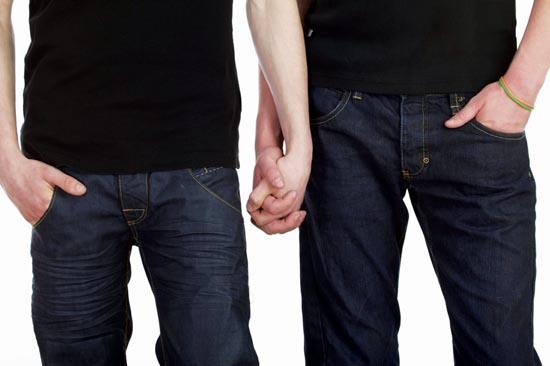
 Prev
Prev
